%20%20--%3E%0A%3Csvg%20version%3D%221.1%22%20xmlns%3D%22http%3A%2F%2Fwww.w3.org%2F2000%2Fsvg%22%20xmlns%3Axlink%3D%22http%3A%2F%2Fwww.w3.org%2F1999%2Fxlink%22%20x%3D%220px%22%20y%3D%220px%22%0A%09%20viewBox%3D%220%200%201055.1%20200%22%20style%3D%22enable-background%3Anew%200%200%201055.1%20200%3B%22%20xml%3Aspace%3D%22preserve%22%3E%0A%3Cstyle%20type%3D%22text%2Fcss%22%3E%0A%09.st0%7Bfill%3A%23231F20%3B%7D%0A%09.st1%7Bfill%3A%230E203C%3B%7D%0A%09.st2%7Bfill%3A%23EC4324%3B%7D%0A%09.st3%7Bfill%3A%23FFFFFF%3B%7D%0A%3C%2Fstyle%3E%0A%3Cg%20id%3D%22Template%22%3E%0A%3C%2Fg%3E%0A%3Cg%20id%3D%22Layer_2%22%3E%0A%09%3Cpath%20class%3D%22st3%22%20d%3D%22M58.3%2C200.3h82.4c12.4%2C0%2C21.7-1.5%2C28-4.5c20.2-9.6%2C30.2-26.1%2C30.2-49.3c0-3.2-0.2-9.3-0.6-18.3h-65.1v14.9%0A%09%09c-0.9%2C3.9-3.4%2C5.8-7.5%2C5.8H73.2c-5%2C0-7.5-2.5-7.5-7.5V59.2c0-5%2C2.5-7.5%2C7.5-7.5h52.5c5%2C0%2C7.5%2C2.1%2C7.5%2C6.4v10.8h65.7V55.7%0A%09%09c0-16.3-3.8-28.3-11.4-36.1c-8.8-12.9-24.7-19.3-47.4-19.3H58.9C47%2C0.3%2C38%2C1.7%2C32%2C4.3c-21.3%2C9-32%2C26.1-32%2C51.4v88%0A%09%09c0%2C16.5%2C3.6%2C28.7%2C10.9%2C36.6C20.1%2C193.7%2C35.9%2C200.3%2C58.3%2C200.3z%22%2F%3E%0A%09%3Cpolygon%20class%3D%22st3%22%20points%3D%22596.6%2C64%20596.6%2C0.8%20400.1%2C0.8%20400.1%2C64%20442.7%2C64%20442.7%2C51.3%20466.1%2C51.3%20466.1%2C148.1%20442.1%2C148.1%20%0A%09%09442.1%2C199.9%20554.8%2C199.9%20554.8%2C148.1%20531.5%2C148.1%20531.5%2C51.4%20554.8%2C51.4%20554.8%2C64%20%09%22%2F%3E%0A%09%3Cpolygon%20class%3D%22st3%22%20points%3D%22942.4%2C148.5%20942.4%2C200.2%201055.1%2C200.2%201055.1%2C148.5%201031.8%2C148.5%201031.8%2C51.2%201055.1%2C51.2%201055.1%2C0.8%20%0A%09%09943.1%2C0.8%20943.1%2C51.3%20966.3%2C51.3%20966.3%2C80%20888.9%2C80%20888.9%2C51.3%20912.6%2C51.3%20912.6%2C0.5%20800.1%2C0.8%20800.1%2C51.4%20823.5%2C51.4%20823.5%2C148.6%20%0A%09%09800.1%2C148.6%20800.1%2C200.1%20912.6%2C200.1%20912.6%2C148.6%20888.9%2C148.6%20888.9%2C116.4%20966.3%2C116.4%20966.3%2C148.5%20%09%22%2F%3E%0A%09%3Cpolygon%20class%3D%22st2%22%20points%3D%22315.5%2C83.9%20299.6%2C34.9%20283.7%2C83.9%20232.2%2C83.9%20273.9%2C114.1%20258%2C163.1%20299.6%2C132.8%20341.3%2C163.1%20%0A%09%09325.4%2C114.1%20367%2C83.9%20%09%22%2F%3E%0A%09%3Cpolygon%20class%3D%22st2%22%20points%3D%22715.6%2C83.9%20699.7%2C34.9%20683.8%2C83.9%20632.3%2C83.9%20674%2C114.1%20658%2C163.1%20699.7%2C132.8%20741.3%2C163.1%20%0A%09%09725.4%2C114.1%20767.1%2C83.9%20%09%22%2F%3E%0A%3C%2Fg%3E%0A%3C%2Fsvg%3E%0A)

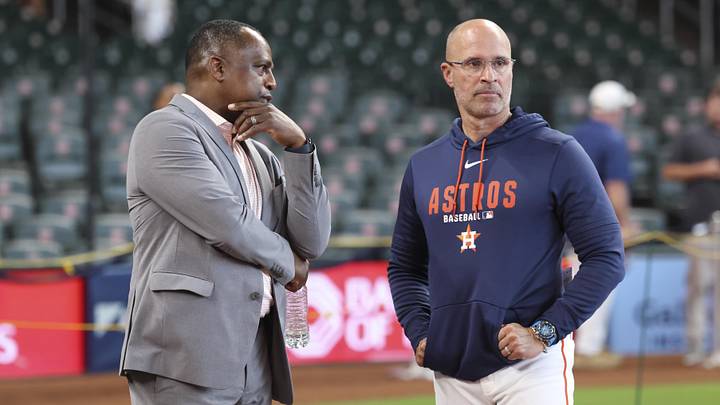
There is so much parity in the American League and the American League West that there’s a world where everything Dana Brown said this week ages well. Maybe the division stays off, the injured players come back and click, and a team that spent April looking up at basically everyone ends up buying at the deadline and gets to October just like the Houston Astros did a couple of seasons ago. That world is both real and possible.
But the issue is that Brown wasn’t speaking like a man who was weighing his options when he said there have been zero conversations about moving Yordan Alvarez or Jeremy Peña. He spoke like someone who had already made up his mind about the plans at the deadline.
Dana Brown shuts the door on a Yordan Alvarez or Jeremy Peña trade
Brown didn’t hedge on the question when asked if his two best hitters could be available at the deadline. Both are pillars who hit at the top of the order, and a contender doesn’t deal pillars. In his words, being a seller is a feeling like the team failed. Which feels like far too much certainty in words for a team still under .500 as we approach the middle of June.
To be fair, the Astros have worked their way back to relevance and sit just 5.5 games back of the division and 2.5 games back of the third Wild Card as of the start of play Wednesday. Jose Altuve and Josh Hader are back. Hunter Brown is close. The roster is close to being whole, so this isn’t a doom spiral, but the framing of the thing as binary is the actual problem here.
Nobody's really moving Alvarez, so let's be honest about it
It’s at least understandable that Alvarez isn’t going anywhere. If we’re being honest, the idea that he could be moved was much of a thought experiment than an actual possibility. With Aaron Judge hurt, he looks to be battling Bobby Witt Jr. for the AL MVP this year as he’s at or near the top of the league in most offensive categories. He’s also locked in at a reasonable rate for two more years after this season, which is both why he’d be insanely valuable in a trade but is probably more valuable for the Astros.
The real conversation centers around Peña and the fact that Brown refuses to have the conversation is an issue.
The case for at least picking up the phone on Peña
Jeff Passan's early deadline preview named Peña the best player who could realistically be available, and the logic is tough to argue with. He's a 28-year-old All-Star and a high-end defensive shortstop who hits a free agent after next season. He also hired Scott Boras, and Astros who hire Boras tend to walk. Crane famously won’t give out the long-term deal these players tend to want, so here we are.
So the Astros have a very good player who is under team control for one more year and will almost certainly leave when that time comes. That is the exact definition of a sell-high candidate. As we laid out last week, this deadline is likely the best the Astros will ever do for him. Passan wasn’t pounding the table for a fire sale. He just said they should explore the idea if the roster doesn’t start playing like a contender.
Peña has been raking too. He had a slow start after he came back from his injury, but he’d been great before hitting a bit of a slide over the last few games. It’s a bit of a back-and-forth because his playing well will help the Astros get back into contention, but also will increase his trade value a fair amount. Again, though, it’s not that they’re wrong to keep him. It’s shortsighted to completely say no to the idea at this moment.
This is a tough needle to thread for the Astros. Their farm system is thin to the point of bare, poorly represented on national prospect lists, and their big league core isn’t getting any younger. Crane has run a win-now operation for a long time, which is appreciated by the fans and has been very beneficial, but it feels like the bill is coming due. Not even considering turning some of the current talent into help for the future is how a contender’s window closes for good.
A big factor here is that Brown is in the final year of his contract. A GM fighting for his job isn’t a great spot to be in as an organization. He has every incentive to shove the chips in and sell for a future that he might not even be around to see. If you think about his viewpoint on selling in that light, it does land a bit differently. He does have recent Astros history to go by when thinking they can make a run, but betting the next five to 10 years on it is a risky choice.
Maybe the Astros get really hot and get over the hump and take over the division or secure a Wild Card. Great! But refusing to discuss the obvious is simply stubbornness dressed up as conviction. A smart front office is willing to entertain all possibilities and determine where they are when the time comes, but Brown doesn’t seem to be doing that. If he doesn’t reverse course, it could be a long-term detriment to the franchise. But maybe he doesn’t care all that much because he won’t be around to worry about it.
 Add us as a preferred source on Google