%20%20--%3E%0A%3Csvg%20version%3D%221.1%22%20xmlns%3D%22http%3A%2F%2Fwww.w3.org%2F2000%2Fsvg%22%20xmlns%3Axlink%3D%22http%3A%2F%2Fwww.w3.org%2F1999%2Fxlink%22%20x%3D%220px%22%20y%3D%220px%22%0A%09%20viewBox%3D%220%200%201055.1%20200%22%20style%3D%22enable-background%3Anew%200%200%201055.1%20200%3B%22%20xml%3Aspace%3D%22preserve%22%3E%0A%3Cstyle%20type%3D%22text%2Fcss%22%3E%0A%09.st0%7Bfill%3A%23231F20%3B%7D%0A%09.st1%7Bfill%3A%230E203C%3B%7D%0A%09.st2%7Bfill%3A%23EC4324%3B%7D%0A%09.st3%7Bfill%3A%23FFFFFF%3B%7D%0A%3C%2Fstyle%3E%0A%3Cg%20id%3D%22Template%22%3E%0A%3C%2Fg%3E%0A%3Cg%20id%3D%22Layer_2%22%3E%0A%09%3Cpath%20class%3D%22st3%22%20d%3D%22M58.3%2C200.3h82.4c12.4%2C0%2C21.7-1.5%2C28-4.5c20.2-9.6%2C30.2-26.1%2C30.2-49.3c0-3.2-0.2-9.3-0.6-18.3h-65.1v14.9%0A%09%09c-0.9%2C3.9-3.4%2C5.8-7.5%2C5.8H73.2c-5%2C0-7.5-2.5-7.5-7.5V59.2c0-5%2C2.5-7.5%2C7.5-7.5h52.5c5%2C0%2C7.5%2C2.1%2C7.5%2C6.4v10.8h65.7V55.7%0A%09%09c0-16.3-3.8-28.3-11.4-36.1c-8.8-12.9-24.7-19.3-47.4-19.3H58.9C47%2C0.3%2C38%2C1.7%2C32%2C4.3c-21.3%2C9-32%2C26.1-32%2C51.4v88%0A%09%09c0%2C16.5%2C3.6%2C28.7%2C10.9%2C36.6C20.1%2C193.7%2C35.9%2C200.3%2C58.3%2C200.3z%22%2F%3E%0A%09%3Cpolygon%20class%3D%22st3%22%20points%3D%22596.6%2C64%20596.6%2C0.8%20400.1%2C0.8%20400.1%2C64%20442.7%2C64%20442.7%2C51.3%20466.1%2C51.3%20466.1%2C148.1%20442.1%2C148.1%20%0A%09%09442.1%2C199.9%20554.8%2C199.9%20554.8%2C148.1%20531.5%2C148.1%20531.5%2C51.4%20554.8%2C51.4%20554.8%2C64%20%09%22%2F%3E%0A%09%3Cpolygon%20class%3D%22st3%22%20points%3D%22942.4%2C148.5%20942.4%2C200.2%201055.1%2C200.2%201055.1%2C148.5%201031.8%2C148.5%201031.8%2C51.2%201055.1%2C51.2%201055.1%2C0.8%20%0A%09%09943.1%2C0.8%20943.1%2C51.3%20966.3%2C51.3%20966.3%2C80%20888.9%2C80%20888.9%2C51.3%20912.6%2C51.3%20912.6%2C0.5%20800.1%2C0.8%20800.1%2C51.4%20823.5%2C51.4%20823.5%2C148.6%20%0A%09%09800.1%2C148.6%20800.1%2C200.1%20912.6%2C200.1%20912.6%2C148.6%20888.9%2C148.6%20888.9%2C116.4%20966.3%2C116.4%20966.3%2C148.5%20%09%22%2F%3E%0A%09%3Cpolygon%20class%3D%22st2%22%20points%3D%22315.5%2C83.9%20299.6%2C34.9%20283.7%2C83.9%20232.2%2C83.9%20273.9%2C114.1%20258%2C163.1%20299.6%2C132.8%20341.3%2C163.1%20%0A%09%09325.4%2C114.1%20367%2C83.9%20%09%22%2F%3E%0A%09%3Cpolygon%20class%3D%22st2%22%20points%3D%22715.6%2C83.9%20699.7%2C34.9%20683.8%2C83.9%20632.3%2C83.9%20674%2C114.1%20658%2C163.1%20699.7%2C132.8%20741.3%2C163.1%20%0A%09%09725.4%2C114.1%20767.1%2C83.9%20%09%22%2F%3E%0A%3C%2Fg%3E%0A%3C%2Fsvg%3E%0A)

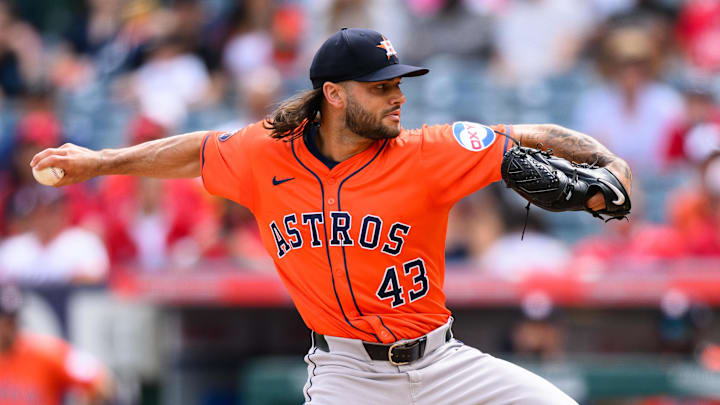
Despite a litany of other options, Lance McCullers Jr. is as much of a lock as any non-Hunter Brown pitcher could be to begin the 2026 season in the Houston Astros' starting rotation. There are 17 million reasons why. This is the final year of the five-year, $85 million contract he signed with the club, which took effect in 2022. So far, Houston has squeezed just 0.6 fWAR out of the deal. They are desperate to make good.
That doesn't mean that McCullers will remain in the rotation as the season unfolds, though. In order to keep his place, he'll have to perform. He has a plan to make that happen, and it doesn't make a ton of sense.
After his March 10 start against the Baltimore Orioles, an affair in which he racked up four strikeouts but allowed three hits, a walk, a homer, and two earned runs over three innings, he proclaimed that he's switching his approach and no longer chasing strikeouts in 2026.
Will it work? It's doubtful, and there are a variety of reasons why.
Astros starter Lance McCullers Jr. says he's done chasing strikeouts
If there is one thing the 32-year-old has always done well it's get strikeouts. Even in the misery that was 2025, he still recorded more than a strikeout per inning, finishing the year with 9.92 K/9. To move away from that would require pinpoint location and a propensity to limit hard contact.
Based on last year's results, McCullers doesn't have the command to pull this off. The right-hander posted a career-worst 14.2% walk rate. That was combined with a 50% hard-hit rate (first percentile finish), an 11.4% barrel rate (seventh percentile), and a 90.5 miles per hour average exit velocity (12th percentile), indicating that he didn't locate well in the zone either.
His statements are also incongruous with his actual approach and performance against Baltimore. Last season, the injury-prone hurler relied heavily on his sinker, and one of the few positives in an otherwise bleak year was that it allowed him to generate a lot of ground balls, coming in at a 47.5% clip.
Against the Orioles, he only used the sinker 13% of the time, cutting its utilization nearly in half from last year's 25% mark. In its place, he relied much more heavily on his four-seamer, throwing the pitch 23% of the time, up from 5% last season. One would think that more heaters would mean chasing more strikeouts. That's especially true when you realize it had more life on it than it did last year, averaging 93.2 miles per hour during the outing, up from 91.8 miles per hour in 2025.
Pitching to contact means having excellent location, and per Pitcher List, his location during the start graded out as a D+.
Lance McCullers Jr. (HOU) struck out four over three innings on Tuesday pic.twitter.com/98yGICyfM1
— Pitcher List Stats (@PitcherListPLV) March 10, 2026
Throwing a bunch of high fastballs, many of which were poorly located, and calling it pitching to contact seems misguided. In fact, it could be a recipe for disaster.
McCullers, somehow returning to his pre-injury form, would be a gigantic boost for the Astros and their playoff hopes, though it's hard to see how that happens with this approach. The extra zip on his heater would seem to indicate that his arm is stronger than it was last year, so at that point, why not lean into what has worked during his most successful campaigns? He's never been considered a crafty control artist, so why start reinventing himself now, just when it seems that his stuff is finally beginning to return?
As the saying goes, ride the horse that got you here. For McCullers, the horse that earned him that fat contract was his ability to get strikeouts in bunches. If his arm is feeling better, that's exactly what he should continue to do.
 Add us as a preferred source on Google