%20%20--%3E%0A%3Csvg%20version%3D%221.1%22%20xmlns%3D%22http%3A%2F%2Fwww.w3.org%2F2000%2Fsvg%22%20xmlns%3Axlink%3D%22http%3A%2F%2Fwww.w3.org%2F1999%2Fxlink%22%20x%3D%220px%22%20y%3D%220px%22%0A%09%20viewBox%3D%220%200%201055.1%20200%22%20style%3D%22enable-background%3Anew%200%200%201055.1%20200%3B%22%20xml%3Aspace%3D%22preserve%22%3E%0A%3Cstyle%20type%3D%22text%2Fcss%22%3E%0A%09.st0%7Bfill%3A%23231F20%3B%7D%0A%09.st1%7Bfill%3A%230E203C%3B%7D%0A%09.st2%7Bfill%3A%23EC4324%3B%7D%0A%09.st3%7Bfill%3A%23FFFFFF%3B%7D%0A%3C%2Fstyle%3E%0A%3Cg%20id%3D%22Template%22%3E%0A%3C%2Fg%3E%0A%3Cg%20id%3D%22Layer_2%22%3E%0A%09%3Cpath%20class%3D%22st3%22%20d%3D%22M58.3%2C200.3h82.4c12.4%2C0%2C21.7-1.5%2C28-4.5c20.2-9.6%2C30.2-26.1%2C30.2-49.3c0-3.2-0.2-9.3-0.6-18.3h-65.1v14.9%0A%09%09c-0.9%2C3.9-3.4%2C5.8-7.5%2C5.8H73.2c-5%2C0-7.5-2.5-7.5-7.5V59.2c0-5%2C2.5-7.5%2C7.5-7.5h52.5c5%2C0%2C7.5%2C2.1%2C7.5%2C6.4v10.8h65.7V55.7%0A%09%09c0-16.3-3.8-28.3-11.4-36.1c-8.8-12.9-24.7-19.3-47.4-19.3H58.9C47%2C0.3%2C38%2C1.7%2C32%2C4.3c-21.3%2C9-32%2C26.1-32%2C51.4v88%0A%09%09c0%2C16.5%2C3.6%2C28.7%2C10.9%2C36.6C20.1%2C193.7%2C35.9%2C200.3%2C58.3%2C200.3z%22%2F%3E%0A%09%3Cpolygon%20class%3D%22st3%22%20points%3D%22596.6%2C64%20596.6%2C0.8%20400.1%2C0.8%20400.1%2C64%20442.7%2C64%20442.7%2C51.3%20466.1%2C51.3%20466.1%2C148.1%20442.1%2C148.1%20%0A%09%09442.1%2C199.9%20554.8%2C199.9%20554.8%2C148.1%20531.5%2C148.1%20531.5%2C51.4%20554.8%2C51.4%20554.8%2C64%20%09%22%2F%3E%0A%09%3Cpolygon%20class%3D%22st3%22%20points%3D%22942.4%2C148.5%20942.4%2C200.2%201055.1%2C200.2%201055.1%2C148.5%201031.8%2C148.5%201031.8%2C51.2%201055.1%2C51.2%201055.1%2C0.8%20%0A%09%09943.1%2C0.8%20943.1%2C51.3%20966.3%2C51.3%20966.3%2C80%20888.9%2C80%20888.9%2C51.3%20912.6%2C51.3%20912.6%2C0.5%20800.1%2C0.8%20800.1%2C51.4%20823.5%2C51.4%20823.5%2C148.6%20%0A%09%09800.1%2C148.6%20800.1%2C200.1%20912.6%2C200.1%20912.6%2C148.6%20888.9%2C148.6%20888.9%2C116.4%20966.3%2C116.4%20966.3%2C148.5%20%09%22%2F%3E%0A%09%3Cpolygon%20class%3D%22st2%22%20points%3D%22315.5%2C83.9%20299.6%2C34.9%20283.7%2C83.9%20232.2%2C83.9%20273.9%2C114.1%20258%2C163.1%20299.6%2C132.8%20341.3%2C163.1%20%0A%09%09325.4%2C114.1%20367%2C83.9%20%09%22%2F%3E%0A%09%3Cpolygon%20class%3D%22st2%22%20points%3D%22715.6%2C83.9%20699.7%2C34.9%20683.8%2C83.9%20632.3%2C83.9%20674%2C114.1%20658%2C163.1%20699.7%2C132.8%20741.3%2C163.1%20%0A%09%09725.4%2C114.1%20767.1%2C83.9%20%09%22%2F%3E%0A%3C%2Fg%3E%0A%3C%2Fsvg%3E%0A)

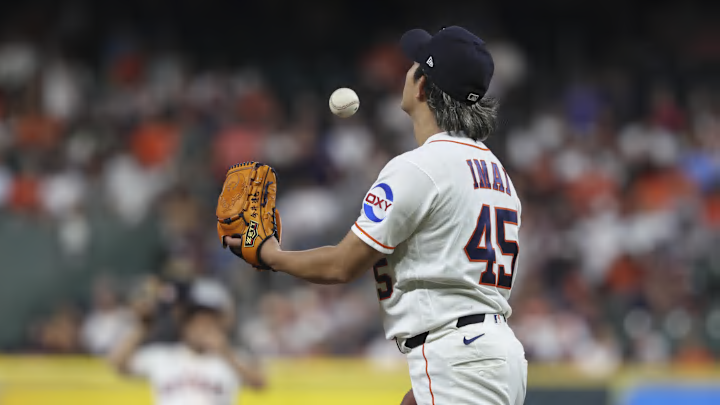
Houston Astros starting pitcher Tatsuya Imai appeared to have struck out Randy Arozarena for the first out of the fourth inning on Tuesday night, but Arozarena challenged, and the call was overturned. It missed by less than a tenth of an inch, but Imai never recovered. He hit Arozarena with the next pitch and hit Luke Raley in the very next plate appearance. Then a walk. And then, boom, a grand slam. He finished the inning, but Imai’s night was done with six runs allowed on five hits with three walks and three strikeouts.
The Mariners simply didn't miss. They put 13 balls in play, and 10 were hit at 95 MPH or harder, with eight of those hit 100 MPH or harder. Joe Espada has confirmed that Imai will make his next start. They simply don’t have the luxury of moving away from him because of both available options and, well, the money they have tied up in him.
Imai signed for three years and $54 million in January, which was their first real foray into the Japanese market, and that commitment is actually larger than the number suggests, as the Astros had to pay the Seibu Lions $9.975 million plus 15 percent of any exercised options. He was compared to Yoshinobu Yamamoto at the GM Meetings by his agent, Scott Boras.
Tatsuya Imai has been a disaster for the Astros
The early returns have not remotely lived up to that billing. Imai has a 9.24 ERA in 12.2 innings over four starts, with the most recent coming after a month on the IL with arm fatigue. His two rehab starts weren't encouraging either. The command issues that ultimately landed him on the IL clearly haven't been resolved, and against the Mariners, he leaned on essentially two pitches, throwing 50 sinkers and 30 sliders, in a league that has a habit of punishing predictability.
So this is a deal with posting fees that is closer to $64 million. And four starts in, he’s looking like he might challenge some of the biggest free agent busts in Astros history.
In November 2022, the Astros were fresh off a World Series title and gave Jose Abreu three years and $58.5 million. He’d won MVP in the shortened 2020 and had a solid year the year before. But by the middle of June, less than two years later, they released him with $30.8 million still owed on his contract. He had hit .124 in his final 35 games with a .361 OPS. He agreed to a minor league assignment to try to find a swing that he never did find.
Days after the title in 2022, Jim Crane effectively pushed out GM James Click and took charge of baseball operations. He gave Rafael Montero $34.5 million, which was (and still is) one of the richest free agent contracts for a non-closing reliever. It was based on one admittedly excellent season, but he never did it again. Montero posted a 5.08 ERA in 67.1 innings in 2023, a 4.70 ERA in 38.1 innings in 2024, and was ultimately traded to the Braves with a Player to be Named Later for cash.
Imay is, at minimum, the most expensive of the three on average annual value. He’s also the only one signed to be a rotation rather than a bat that fits as part of the solution or a back-end arm. The Astros didn’t bring him to the organization for depth. They brought him to Houston to start and be successful.
There is a history here of handing out money that later became a regret. There is a pretty common thread among all the deals. They go wrong because of a sudden performance cliff that the team didn’t see coming. Carlos Lee, for example, is still the team’s largest free agent deal at six years and $100 million. He produced exactly one 30-homer season after signing, though he did have a couple of other nice years in Houston before being moved in a forgetful trade. Josh Reddick’s four-year deal looked excellent to start, but the results there were less than promising.
The case for patience is easy to see. Four starts are barely a blip in a career, and Imai has admitted there’s still an adjustment period to so much about the game stateside. Even Yamamoto had moments of shakiness (though not like this) before becoming the World Series MVP he now is.
But the warning signs are flashing pretty brightly. He’s working with just two pitches and command that comes and goes without much warning. He’s given up hard contact, and his manager has essentially thrown his hands in the air and said there isn’t a Plan B. Three years from now, they may look back on the signing as a market entry that paid off, even if Imai doesn’t figure it out. Or they may look back on the deal similarly to how they see the Abreu and Montero deals. For now, they’re hoping Imai pitches well enough to opt out of his deal, though that feels like a nearly impossible outcome at this moment.
 Add us as a preferred source on Google