%20%20--%3E%0A%3Csvg%20version%3D%221.1%22%20xmlns%3D%22http%3A%2F%2Fwww.w3.org%2F2000%2Fsvg%22%20xmlns%3Axlink%3D%22http%3A%2F%2Fwww.w3.org%2F1999%2Fxlink%22%20x%3D%220px%22%20y%3D%220px%22%0A%09%20viewBox%3D%220%200%201055.1%20200%22%20style%3D%22enable-background%3Anew%200%200%201055.1%20200%3B%22%20xml%3Aspace%3D%22preserve%22%3E%0A%3Cstyle%20type%3D%22text%2Fcss%22%3E%0A%09.st0%7Bfill%3A%23231F20%3B%7D%0A%09.st1%7Bfill%3A%230E203C%3B%7D%0A%09.st2%7Bfill%3A%23EC4324%3B%7D%0A%09.st3%7Bfill%3A%23FFFFFF%3B%7D%0A%3C%2Fstyle%3E%0A%3Cg%20id%3D%22Template%22%3E%0A%3C%2Fg%3E%0A%3Cg%20id%3D%22Layer_2%22%3E%0A%09%3Cpath%20class%3D%22st3%22%20d%3D%22M58.3%2C200.3h82.4c12.4%2C0%2C21.7-1.5%2C28-4.5c20.2-9.6%2C30.2-26.1%2C30.2-49.3c0-3.2-0.2-9.3-0.6-18.3h-65.1v14.9%0A%09%09c-0.9%2C3.9-3.4%2C5.8-7.5%2C5.8H73.2c-5%2C0-7.5-2.5-7.5-7.5V59.2c0-5%2C2.5-7.5%2C7.5-7.5h52.5c5%2C0%2C7.5%2C2.1%2C7.5%2C6.4v10.8h65.7V55.7%0A%09%09c0-16.3-3.8-28.3-11.4-36.1c-8.8-12.9-24.7-19.3-47.4-19.3H58.9C47%2C0.3%2C38%2C1.7%2C32%2C4.3c-21.3%2C9-32%2C26.1-32%2C51.4v88%0A%09%09c0%2C16.5%2C3.6%2C28.7%2C10.9%2C36.6C20.1%2C193.7%2C35.9%2C200.3%2C58.3%2C200.3z%22%2F%3E%0A%09%3Cpolygon%20class%3D%22st3%22%20points%3D%22596.6%2C64%20596.6%2C0.8%20400.1%2C0.8%20400.1%2C64%20442.7%2C64%20442.7%2C51.3%20466.1%2C51.3%20466.1%2C148.1%20442.1%2C148.1%20%0A%09%09442.1%2C199.9%20554.8%2C199.9%20554.8%2C148.1%20531.5%2C148.1%20531.5%2C51.4%20554.8%2C51.4%20554.8%2C64%20%09%22%2F%3E%0A%09%3Cpolygon%20class%3D%22st3%22%20points%3D%22942.4%2C148.5%20942.4%2C200.2%201055.1%2C200.2%201055.1%2C148.5%201031.8%2C148.5%201031.8%2C51.2%201055.1%2C51.2%201055.1%2C0.8%20%0A%09%09943.1%2C0.8%20943.1%2C51.3%20966.3%2C51.3%20966.3%2C80%20888.9%2C80%20888.9%2C51.3%20912.6%2C51.3%20912.6%2C0.5%20800.1%2C0.8%20800.1%2C51.4%20823.5%2C51.4%20823.5%2C148.6%20%0A%09%09800.1%2C148.6%20800.1%2C200.1%20912.6%2C200.1%20912.6%2C148.6%20888.9%2C148.6%20888.9%2C116.4%20966.3%2C116.4%20966.3%2C148.5%20%09%22%2F%3E%0A%09%3Cpolygon%20class%3D%22st2%22%20points%3D%22315.5%2C83.9%20299.6%2C34.9%20283.7%2C83.9%20232.2%2C83.9%20273.9%2C114.1%20258%2C163.1%20299.6%2C132.8%20341.3%2C163.1%20%0A%09%09325.4%2C114.1%20367%2C83.9%20%09%22%2F%3E%0A%09%3Cpolygon%20class%3D%22st2%22%20points%3D%22715.6%2C83.9%20699.7%2C34.9%20683.8%2C83.9%20632.3%2C83.9%20674%2C114.1%20658%2C163.1%20699.7%2C132.8%20741.3%2C163.1%20%0A%09%09725.4%2C114.1%20767.1%2C83.9%20%09%22%2F%3E%0A%3C%2Fg%3E%0A%3C%2Fsvg%3E%0A)

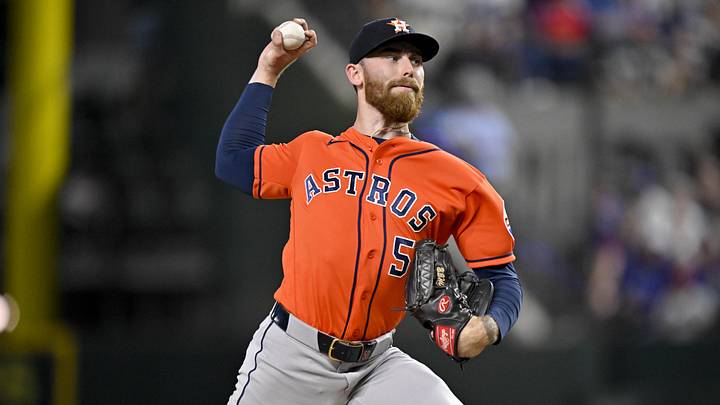
In a way, Mike Burrows was the biggest investment the Houston Astros made over the offseason. Tatsuya Imai cost significantly more in terms of money, but the price of acquisition for Burrows was Jacob Melton and Anderson Brito, who Baseball America ranked first and third in Houston's farm system, respectively.
That was particularly costly given the barren nature of the Astros' farm system. The Tampa Bay Rays hyped Melton up considerably during the offseason. One can argue that with Melton posting a strikeout rate hovering above 40% in Triple-A and Brito struggling with walks in High-A, that they weren't big losses, but that's not the point.
This is about opportunity costs; what these youngsters could have fetched elsewhere, and Houston's decision to step into the wildly expensive starting pitcher trade market.
Burrows was a high-potential, but unproven arm at the time of the trade. Hopes were high that he'd stabilize a rotation that needed several answers behind Hunter Brown. To say he's been a disaster relative to that goal is an understatement.
But the young right-hander's latest start against the Texas Rangers on May 27 might indicate that he's begun to turn things around. He logged seven innings, tying a season high, while striking out six and allowing five hits, one walk, and two earned runs in the winning effort.
The Astros need Mike Burrows to string together quality starts
Burrows reached the seven-inning plateau one other time this season, coming on May 8 against the Cincinnati Reds. In that outing, he was even more dominant, going exactly seven frames without allowing an earned run. However, his next start on May 14 might have been his worst of the season as he allowed seven earned over 5⅔ against the Seattle Mariners.
Finding consistency has been one of the biggest issues for the 26-year-old. He's had a couple of other solid performances, like his eight-strikeout performance against the mighty New York Yankees' lineup on April 25, but they've routinely been followed up by duds. Even with his last performance in the books, his ERA still sits at 5.40 on the season because of this.
Burrow's is something of a paradox. He does a good job suppressing hard contact. His average exit velocity is 87.6 miles per hour, which is solidly above average in the 73rd percentile. His hard-hit rate is just 36%, coming in as a 67th percentile performance.
Yet, Burrows gets hit a lot. He's allowed the fifth-most hits among MLB with 71, despite throwing the second-fewest innings among that group. He's given up 13 dingers this year, which puts him in a five-way tie for the second-most in baseball behind Jameson Taillon of the Chicago Cubs. It's been an issue that he has carried over from last year.
If Burrows can finally start stringing together solid performances, it could be a huge boon for the Astros. Brown will be returning soon, and as pitiful as the rotation began the year, it has started to round into form with strong performances from Spencer Arrighetti, Kai-Wei Teng, and Peter Lambert.
A productive Burrows, combined with Brown and that trio, could give Houston a group that is more than functional and can also log innings to help reduce the strain on the beleaguered bullpen.
The Astros sit just behind the Mariners for first place in the AL West, so finally getting the rotation sorted with Burrows' help could truly help them make a run. Much of this depends on Burrows finally being consistent. To that end, his upcoming start on June 2 against his former team, the Pittsburgh Pirates, will tell us a lot about whether or not he can get it together.
 Add us as a preferred source on Google