%20%20--%3E%0A%3Csvg%20version%3D%221.1%22%20xmlns%3D%22http%3A%2F%2Fwww.w3.org%2F2000%2Fsvg%22%20xmlns%3Axlink%3D%22http%3A%2F%2Fwww.w3.org%2F1999%2Fxlink%22%20x%3D%220px%22%20y%3D%220px%22%0A%09%20viewBox%3D%220%200%201055.1%20200%22%20style%3D%22enable-background%3Anew%200%200%201055.1%20200%3B%22%20xml%3Aspace%3D%22preserve%22%3E%0A%3Cstyle%20type%3D%22text%2Fcss%22%3E%0A%09.st0%7Bfill%3A%23231F20%3B%7D%0A%09.st1%7Bfill%3A%230E203C%3B%7D%0A%09.st2%7Bfill%3A%23EC4324%3B%7D%0A%09.st3%7Bfill%3A%23FFFFFF%3B%7D%0A%3C%2Fstyle%3E%0A%3Cg%20id%3D%22Template%22%3E%0A%3C%2Fg%3E%0A%3Cg%20id%3D%22Layer_2%22%3E%0A%09%3Cpath%20class%3D%22st3%22%20d%3D%22M58.3%2C200.3h82.4c12.4%2C0%2C21.7-1.5%2C28-4.5c20.2-9.6%2C30.2-26.1%2C30.2-49.3c0-3.2-0.2-9.3-0.6-18.3h-65.1v14.9%0A%09%09c-0.9%2C3.9-3.4%2C5.8-7.5%2C5.8H73.2c-5%2C0-7.5-2.5-7.5-7.5V59.2c0-5%2C2.5-7.5%2C7.5-7.5h52.5c5%2C0%2C7.5%2C2.1%2C7.5%2C6.4v10.8h65.7V55.7%0A%09%09c0-16.3-3.8-28.3-11.4-36.1c-8.8-12.9-24.7-19.3-47.4-19.3H58.9C47%2C0.3%2C38%2C1.7%2C32%2C4.3c-21.3%2C9-32%2C26.1-32%2C51.4v88%0A%09%09c0%2C16.5%2C3.6%2C28.7%2C10.9%2C36.6C20.1%2C193.7%2C35.9%2C200.3%2C58.3%2C200.3z%22%2F%3E%0A%09%3Cpolygon%20class%3D%22st3%22%20points%3D%22596.6%2C64%20596.6%2C0.8%20400.1%2C0.8%20400.1%2C64%20442.7%2C64%20442.7%2C51.3%20466.1%2C51.3%20466.1%2C148.1%20442.1%2C148.1%20%0A%09%09442.1%2C199.9%20554.8%2C199.9%20554.8%2C148.1%20531.5%2C148.1%20531.5%2C51.4%20554.8%2C51.4%20554.8%2C64%20%09%22%2F%3E%0A%09%3Cpolygon%20class%3D%22st3%22%20points%3D%22942.4%2C148.5%20942.4%2C200.2%201055.1%2C200.2%201055.1%2C148.5%201031.8%2C148.5%201031.8%2C51.2%201055.1%2C51.2%201055.1%2C0.8%20%0A%09%09943.1%2C0.8%20943.1%2C51.3%20966.3%2C51.3%20966.3%2C80%20888.9%2C80%20888.9%2C51.3%20912.6%2C51.3%20912.6%2C0.5%20800.1%2C0.8%20800.1%2C51.4%20823.5%2C51.4%20823.5%2C148.6%20%0A%09%09800.1%2C148.6%20800.1%2C200.1%20912.6%2C200.1%20912.6%2C148.6%20888.9%2C148.6%20888.9%2C116.4%20966.3%2C116.4%20966.3%2C148.5%20%09%22%2F%3E%0A%09%3Cpolygon%20class%3D%22st2%22%20points%3D%22315.5%2C83.9%20299.6%2C34.9%20283.7%2C83.9%20232.2%2C83.9%20273.9%2C114.1%20258%2C163.1%20299.6%2C132.8%20341.3%2C163.1%20%0A%09%09325.4%2C114.1%20367%2C83.9%20%09%22%2F%3E%0A%09%3Cpolygon%20class%3D%22st2%22%20points%3D%22715.6%2C83.9%20699.7%2C34.9%20683.8%2C83.9%20632.3%2C83.9%20674%2C114.1%20658%2C163.1%20699.7%2C132.8%20741.3%2C163.1%20%0A%09%09725.4%2C114.1%20767.1%2C83.9%20%09%22%2F%3E%0A%3C%2Fg%3E%0A%3C%2Fsvg%3E%0A)

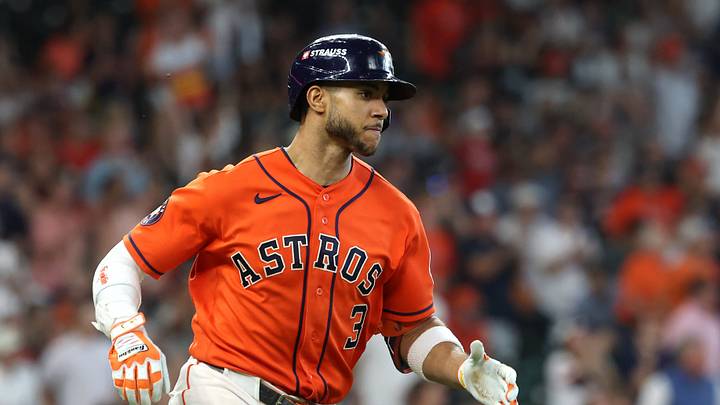
We have mentioned a ton of decisions as we move position by position on the diamond, but they all are leading up to this decision. What do the Houston Astros do with Jeremy Pena? My partner in crime has already made some points there and I have looked at what a theoretical Pena contract might look like. However, I'd like to attack this potential pivot point from multiple angles, because that is what any good general manager would do.
So, what we will do first is take a look at the shortstop landscape minus Pena and see if we can get a range of salaries and what they are producing in terms of WAR. The stat I like to use is WAR per 150 games. Since some people like bWAR (baseball-reference.com WAR) and some people like fWAR (Fangraphs.com WAR) we will use both. We will also include their AAV from their current contract. Jeremy Pena has been playing for five seasons, so we will look at their last five seasons for all options.
Salary | Games | BWAR | FWAR | B/150 | F/150 | |
|---|---|---|---|---|---|---|
Francisco Lindor | 34.1 | 738 | 25.9 | 27.9 | 5.26 | 5.67 |
Trea Turner | 27.3 | 654 | 16.8 | 21.8 | 3.85 | 5.00 |
Dansby Swanson | 27.0 | 743 | 22.4 | 22.4 | 4.52 | 4.52 |
Xander Bogearts | ||||||
Willy Adames | 26.0 | 730 | 15.8 | 17.2 | 3.25 | 3.53 |
Corey Seager | 30.5 | 597 | 25.5 | 21.6 | 6.41 | 5.43 |
Bobby Witt | 21.0 | 769 | 28.7 | 33.6 | 5.60 | 6.55 |
Trevor Story | 22.5 | 384 | 8.4 | 6.9 | 3.28 | 2.70 |
Mookie Betts | 30.4 | 683 | 28.7 | 25.0 | 6.30 | 5.49 |
Carlos Correa | 33.3 | 533 | 13.2 | 14.2 | 3.71 | 4.00 |
Before we get to the averages above, the initial question is likely where Pena fits into this group statistically. I count ten shortstops there, not including Pena. His 680 games played would place him seventh in that group. His 22.2 bWAR would place him sixth. His 17.9 fWAR would place him eighth in the group. His 4.90 bWAR per 150 games places him fifth in that category and his 3.95 fWAR per 150 games puts him in eighth.
We can obviously run some kind of regression analysis, but we can comfortably say he finishes somewhere between fifth and eighth in the group. Below is a simple table of the averages for each of those categories so we see how close Pena comes to the average.
Salary | Games | BWAR | FWAR | B/150 | F/150 | |
|---|---|---|---|---|---|---|
Average | 28.0 | 648 | 20.1 | 20.9 | 4.65 | 4.84 |
I might be nuts, but that looks a lot like Jeremy Pena minus the salary. He played in 680 games, produced 22.2 bWAR and 17.9 fWAR. If you average those out then he is almost exactly the average shortstop in that group. I certainly am not Scott Boras, but if I were, I would have no issue asking for an average salary of $30 million a year and would feel very comfortable knowing I would get that from someone at this point. So, the question is whether the new general manager and Jim Crane want to foot that bill themselves.
A team with a $240 million budget can certainly afford any contract like that. That isn't the question. The question is whether you should. That breaks us down into two primary questions. The first one is whether you think Jeremy Pena can sustain that kind of performance over the life of the contract. The cautionary tales are easy to see in the table above, and one of them plays (or doesn't play) in Houston. We would hope Pena does more than Correa, Story, Adames, and Bogaerts. Again, that would put him near the middle of the list and more than reasonably justify the cost on that end.
The second question is the harder one. Could you do more with those resources if you applied them somewhere else? In other words, could two $15 million players do better than Pena by himself? Could three $10 million players produce more than that? Mathematically, the answer is an easy one if you pick the right two or three players. Of course, nothing is ever quite that simple and that is where we have to ask whether we are simply looking at analytics or if public relations enters into this equation at all.
Let's say that Pena gets an eight-year, $240 million contract. That would be perfectly reasonable given the going rate for these players. If he averaged four wins a season over the course of that contract he would be up to 54 bWAR and 50 fWAR. Those are borderline Hall of Fame numbers. If he had just one more magical postseason run in those eight years, then he would solidify himself as one of the best clutch performers in baseball history as well. That's also 13 seasons in the same place. Suddenly, Pena gets mentioned in the same breath as Jose Altuve, Craig Biggio, and Jeff Bagwell. It's hard to put a price tag on that.
On the flip side, let's say that you can engineer a deal similar to the Kyle Tucker trade. You add two or three useful pieces AND you would shave the amount he gets in arbitration in 2027, which Spotrac estimates will be $13.1 million, but could go as high as $17.5 million. We could estimate that they would save somewhere around $10 million in salary, assuming they get young players in return in a trade. So, you get the value of those players AND whatever you could get for $10 million. That's awfully tempting.
We should know who the head man is in a couple of days when the World Series allows teams to make announcements. This is that new general manager's number one decision of the offseason. You have to decide now whether you are keeping him long-term or getting what you can for him. I don't envy the decision because there are obvious points on both sides of the ledger. One thing is for sure: you can't do nothing. The clock is ticking.
 Add us as a preferred source on Google