%20%20--%3E%0A%3Csvg%20version%3D%221.1%22%20xmlns%3D%22http%3A%2F%2Fwww.w3.org%2F2000%2Fsvg%22%20xmlns%3Axlink%3D%22http%3A%2F%2Fwww.w3.org%2F1999%2Fxlink%22%20x%3D%220px%22%20y%3D%220px%22%0A%09%20viewBox%3D%220%200%201055.1%20200%22%20style%3D%22enable-background%3Anew%200%200%201055.1%20200%3B%22%20xml%3Aspace%3D%22preserve%22%3E%0A%3Cstyle%20type%3D%22text%2Fcss%22%3E%0A%09.st0%7Bfill%3A%23231F20%3B%7D%0A%09.st1%7Bfill%3A%230E203C%3B%7D%0A%09.st2%7Bfill%3A%23EC4324%3B%7D%0A%09.st3%7Bfill%3A%23FFFFFF%3B%7D%0A%3C%2Fstyle%3E%0A%3Cg%20id%3D%22Template%22%3E%0A%3C%2Fg%3E%0A%3Cg%20id%3D%22Layer_2%22%3E%0A%09%3Cpath%20class%3D%22st3%22%20d%3D%22M58.3%2C200.3h82.4c12.4%2C0%2C21.7-1.5%2C28-4.5c20.2-9.6%2C30.2-26.1%2C30.2-49.3c0-3.2-0.2-9.3-0.6-18.3h-65.1v14.9%0A%09%09c-0.9%2C3.9-3.4%2C5.8-7.5%2C5.8H73.2c-5%2C0-7.5-2.5-7.5-7.5V59.2c0-5%2C2.5-7.5%2C7.5-7.5h52.5c5%2C0%2C7.5%2C2.1%2C7.5%2C6.4v10.8h65.7V55.7%0A%09%09c0-16.3-3.8-28.3-11.4-36.1c-8.8-12.9-24.7-19.3-47.4-19.3H58.9C47%2C0.3%2C38%2C1.7%2C32%2C4.3c-21.3%2C9-32%2C26.1-32%2C51.4v88%0A%09%09c0%2C16.5%2C3.6%2C28.7%2C10.9%2C36.6C20.1%2C193.7%2C35.9%2C200.3%2C58.3%2C200.3z%22%2F%3E%0A%09%3Cpolygon%20class%3D%22st3%22%20points%3D%22596.6%2C64%20596.6%2C0.8%20400.1%2C0.8%20400.1%2C64%20442.7%2C64%20442.7%2C51.3%20466.1%2C51.3%20466.1%2C148.1%20442.1%2C148.1%20%0A%09%09442.1%2C199.9%20554.8%2C199.9%20554.8%2C148.1%20531.5%2C148.1%20531.5%2C51.4%20554.8%2C51.4%20554.8%2C64%20%09%22%2F%3E%0A%09%3Cpolygon%20class%3D%22st3%22%20points%3D%22942.4%2C148.5%20942.4%2C200.2%201055.1%2C200.2%201055.1%2C148.5%201031.8%2C148.5%201031.8%2C51.2%201055.1%2C51.2%201055.1%2C0.8%20%0A%09%09943.1%2C0.8%20943.1%2C51.3%20966.3%2C51.3%20966.3%2C80%20888.9%2C80%20888.9%2C51.3%20912.6%2C51.3%20912.6%2C0.5%20800.1%2C0.8%20800.1%2C51.4%20823.5%2C51.4%20823.5%2C148.6%20%0A%09%09800.1%2C148.6%20800.1%2C200.1%20912.6%2C200.1%20912.6%2C148.6%20888.9%2C148.6%20888.9%2C116.4%20966.3%2C116.4%20966.3%2C148.5%20%09%22%2F%3E%0A%09%3Cpolygon%20class%3D%22st2%22%20points%3D%22315.5%2C83.9%20299.6%2C34.9%20283.7%2C83.9%20232.2%2C83.9%20273.9%2C114.1%20258%2C163.1%20299.6%2C132.8%20341.3%2C163.1%20%0A%09%09325.4%2C114.1%20367%2C83.9%20%09%22%2F%3E%0A%09%3Cpolygon%20class%3D%22st2%22%20points%3D%22715.6%2C83.9%20699.7%2C34.9%20683.8%2C83.9%20632.3%2C83.9%20674%2C114.1%20658%2C163.1%20699.7%2C132.8%20741.3%2C163.1%20%0A%09%09725.4%2C114.1%20767.1%2C83.9%20%09%22%2F%3E%0A%3C%2Fg%3E%0A%3C%2Fsvg%3E%0A)

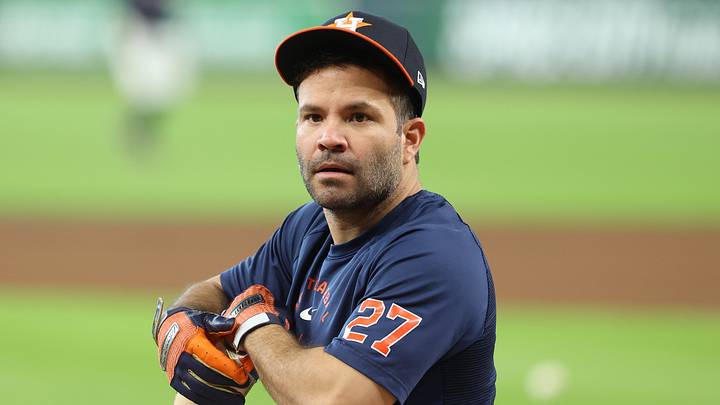
There are important questions every offseason. There are impactful questions every offseason. Yet, there is one question that is the most uncomfortable question this offseason: what do the Astros do with their franchise icon? Every good organization faces this question at one point or another. How these questions are answered tell us a lot about the organization, and there is no real right way or wrong way to handle it.
Some organizations never hang onto their icons once they start to slip. They are bottom-line organizations that feel it is luxury they can't afford. The Milwaukee Brewers and Tampa Bay Rays are at the most successful part of this paradigm. They follow the axiom that it is better to give up a year too early than a year too late. However, fan support in those locations is dependent on competing at the top of the curve. When they don't, the fans don't show up.
In the case of Tampa, that can be blamed on a crappy home ballpark or simply the market they play in, but a part of it is never having an icon finish their career where it started. There is an amount of good will that comes from keeping those guys around, and there is no way to effectively measure that. The other extreme is to keep all of your icons and simply let them play out their careers. Obviously, the good will is there, but the downside is that if you have too many of those guys at one time, then you won't be competitive.
The good news is that Jose Altuve wanted the hometown discount and he structured his deal in a way that acknowledges the obvious. He officially has three years left on his contract, but 2027 is the last year he will be paid like a superstar. He is getting $33 million next season, provided there is baseball. He will get $13 million in 2028 and 2029. At least they won't be paying superstar money for a replacement level player at that point.
However, depending on the source, Altuve was as meager as a replacement level player this last season. This largely depends on the numbers you choose to believe. We will get to those in a minute. However, it highlights the larger issue involved. What do you do with a player when they are no longer good at baseball?
The normal course is to either trade them or cut them. You are not trading or cutting a franchise icon. Besides. what team is offering you anything of value for a depreciating asset? It ends up being a Craig Biggio situation where you knowingly keep writing a player's name in the lineup who is a net negative for your team. Unlike Biggio, the Astros have a choice with Altuve they didn't have with Biggio. First, let's look at the fielding numbers over the last five seasons, according to defensive runs saved, outs above average, and fielding run value.
DRS | OOA | FRV | |
|---|---|---|---|
2022 | -15 | 1 | 4 |
2023 | -13 | -1 | 1 |
2024 | -13 | -8 | -5 |
2025 | -18* | -5* | -6* |
2026 | -17 | -10 | -9 |
* includes left field statistics
Jose Altuve's defensive statistics tell us about his Astros future
FWAR consistently rates Altuve about a win better defensively than bWAR because bWAR relies on defensive runs saved. There is a ton of secret sauce that goes into those numbers, and while I have preferences, all of them provide a context for this particular situation. The most important point is that none of them liked his defense the last two seasons. DRS hasn't liked his defense his whole career.
OOZ and FRV rely more on statcast (meaning computers) while DRS relies on video and a human evaluating the video. All three systems have their fans and their detractors. Statistically speaking, OOZ and FRV tend to depress the superlatives one way or the other. In layman's terms, more of those numbers end up closer to zero than on the DRS end. For most of you, that is the extent of the math you want to digest in one day.
Fortunately for us, baseball-reference does a good job of breaking down numbers into digestible chunks we can use in situations like this. The next obvious question is whether his fielding impacts his hitting. This seems like a stupid question, but it really isn't. Some players hit better when they play the field. There can be any number of reasons for that. So, let me show two players and what they do in terms of the slash statistics at their position (we will include LF for Altuve) and DH.
AVG | OBP | SLG | |
|---|---|---|---|
Jose Altuve 2B | .302 | .359 | .464 |
Jose Altuve LF | .264 | .323 | .420 |
Jose Altuve DH | .272 | .335 | .441 |
Yordan Alvarez LF | .335 | .423 | .643 |
Yordan Alvarez DH | .286 | .386 | .551 |
These are career numbers. Obviously, much of Altuve's second base production came when he was exclusively playing second base before 2022 when he started to see the occasional DH start. He was better as a DH in limited at bats. I hate small sample sizes, so it doesn't pay to put too much into them, but it seems safe to say that not playing in the field does not seem to hurt his bat any. Yet, Yordan Alvarez goes from being Ted Williams in left field to being a very good, but not exceptional hitter at designated hitter.
The solution seems easier than it really is. For one, Yordan is a negative impact defensive left fielder. It is likely the least valuable defensive position on the diamond, but it's not nothing. Secondly, it seems obvious that there is a chance that Yordan will have to sit out more games if he is playing regularly in the field. I would still rather have a .930 or .940 bat in my lineup more often than a 1.050 hitter more sporadically.
The other problem is that someone will have to play second base. The Astros tried Brendan Rodgers two years ago and that failed miserably. Nick "The Stick" Allen could take over more regularly, but he is a career .600ish OPS hitter. His .700+ OPS last season was likely a mirage, and banking on that for another season is a lousy bet. So, your options are internal options like Brice Matthews or Cavan Biggio, or you can try the trade/free agent market.
It is a lousy situation to be in all the way around. However, if Altuve comes close to that .750ish OPS he has produced as a DH, then he would be an above league-average hitter. That's not worth $33 million, but it also isn't worth nothing. The name of the game from here is maximizing what you have. You have an above average hitter who is a net negative in the field. So, you minimize the negative and accentuate the positive. The good news is that Altuve has always been a team player. He will do what is best for the team if asked. It is time to ask him to transition to DH.
 Add us as a preferred source on Google