%20%20--%3E%0A%3Csvg%20version%3D%221.1%22%20xmlns%3D%22http%3A%2F%2Fwww.w3.org%2F2000%2Fsvg%22%20xmlns%3Axlink%3D%22http%3A%2F%2Fwww.w3.org%2F1999%2Fxlink%22%20x%3D%220px%22%20y%3D%220px%22%0A%09%20viewBox%3D%220%200%201055.1%20200%22%20style%3D%22enable-background%3Anew%200%200%201055.1%20200%3B%22%20xml%3Aspace%3D%22preserve%22%3E%0A%3Cstyle%20type%3D%22text%2Fcss%22%3E%0A%09.st0%7Bfill%3A%23231F20%3B%7D%0A%09.st1%7Bfill%3A%230E203C%3B%7D%0A%09.st2%7Bfill%3A%23EC4324%3B%7D%0A%09.st3%7Bfill%3A%23FFFFFF%3B%7D%0A%3C%2Fstyle%3E%0A%3Cg%20id%3D%22Template%22%3E%0A%3C%2Fg%3E%0A%3Cg%20id%3D%22Layer_2%22%3E%0A%09%3Cpath%20class%3D%22st3%22%20d%3D%22M58.3%2C200.3h82.4c12.4%2C0%2C21.7-1.5%2C28-4.5c20.2-9.6%2C30.2-26.1%2C30.2-49.3c0-3.2-0.2-9.3-0.6-18.3h-65.1v14.9%0A%09%09c-0.9%2C3.9-3.4%2C5.8-7.5%2C5.8H73.2c-5%2C0-7.5-2.5-7.5-7.5V59.2c0-5%2C2.5-7.5%2C7.5-7.5h52.5c5%2C0%2C7.5%2C2.1%2C7.5%2C6.4v10.8h65.7V55.7%0A%09%09c0-16.3-3.8-28.3-11.4-36.1c-8.8-12.9-24.7-19.3-47.4-19.3H58.9C47%2C0.3%2C38%2C1.7%2C32%2C4.3c-21.3%2C9-32%2C26.1-32%2C51.4v88%0A%09%09c0%2C16.5%2C3.6%2C28.7%2C10.9%2C36.6C20.1%2C193.7%2C35.9%2C200.3%2C58.3%2C200.3z%22%2F%3E%0A%09%3Cpolygon%20class%3D%22st3%22%20points%3D%22596.6%2C64%20596.6%2C0.8%20400.1%2C0.8%20400.1%2C64%20442.7%2C64%20442.7%2C51.3%20466.1%2C51.3%20466.1%2C148.1%20442.1%2C148.1%20%0A%09%09442.1%2C199.9%20554.8%2C199.9%20554.8%2C148.1%20531.5%2C148.1%20531.5%2C51.4%20554.8%2C51.4%20554.8%2C64%20%09%22%2F%3E%0A%09%3Cpolygon%20class%3D%22st3%22%20points%3D%22942.4%2C148.5%20942.4%2C200.2%201055.1%2C200.2%201055.1%2C148.5%201031.8%2C148.5%201031.8%2C51.2%201055.1%2C51.2%201055.1%2C0.8%20%0A%09%09943.1%2C0.8%20943.1%2C51.3%20966.3%2C51.3%20966.3%2C80%20888.9%2C80%20888.9%2C51.3%20912.6%2C51.3%20912.6%2C0.5%20800.1%2C0.8%20800.1%2C51.4%20823.5%2C51.4%20823.5%2C148.6%20%0A%09%09800.1%2C148.6%20800.1%2C200.1%20912.6%2C200.1%20912.6%2C148.6%20888.9%2C148.6%20888.9%2C116.4%20966.3%2C116.4%20966.3%2C148.5%20%09%22%2F%3E%0A%09%3Cpolygon%20class%3D%22st2%22%20points%3D%22315.5%2C83.9%20299.6%2C34.9%20283.7%2C83.9%20232.2%2C83.9%20273.9%2C114.1%20258%2C163.1%20299.6%2C132.8%20341.3%2C163.1%20%0A%09%09325.4%2C114.1%20367%2C83.9%20%09%22%2F%3E%0A%09%3Cpolygon%20class%3D%22st2%22%20points%3D%22715.6%2C83.9%20699.7%2C34.9%20683.8%2C83.9%20632.3%2C83.9%20674%2C114.1%20658%2C163.1%20699.7%2C132.8%20741.3%2C163.1%20%0A%09%09725.4%2C114.1%20767.1%2C83.9%20%09%22%2F%3E%0A%3C%2Fg%3E%0A%3C%2Fsvg%3E%0A)

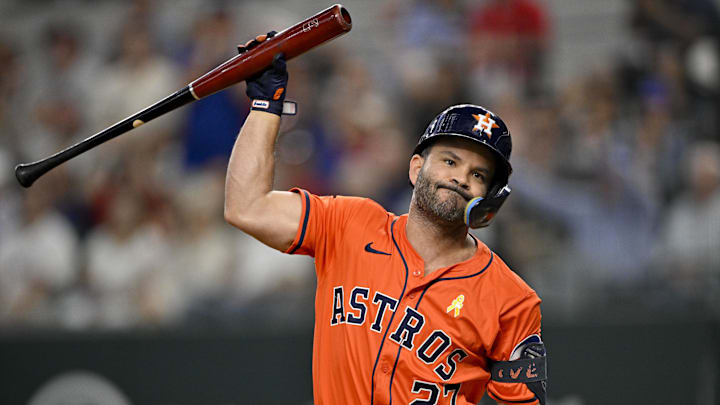
Jose Altuve is the face of the Houston Astros and will be a major key to their success this season. While he's no longer in his prime, the diminutive second baseman's peak was so great that even in a diminished state, he's in a decent position to reach 3,000 hits and put the bow on his Hall of Fame legacy.
However, as the spring has unfolded, it's fair to start worrying about whether or not Altuve can remain a productive player. Entering his age-36 season, the former AL MVP is hitting just .118/.167/.206 over 12 games. More concerning than the overall line is his uncharacteristic 33.3% strikeout rate. For reference, Altuve K'd just 16.7% of the time last season and owns a stellar 13.1% career mark.
Spring stats aren't all that meaningful unless they are extensions of what we've already seen occurring. In Altuve's case, this is why the alarm bells should be ringing. On the surface, his .771 OPS last year might not have reached his vintage, but it appeared to be a solid overall performance.
The actual truth is that the number was significantly skewed by an insanely hot July in which he posted a 1.055 OPS. However, immediately following that hot streak, his performance dipped to its worst point all season with an OPS of .695 in August and .680 in September. Even his better, non-July months, saw him max out at a .745 mark.
Struggling down the stretch is part of what makes the current spring struggles hold more weight. It feels like a continuation rather than a random fluctuation. Altuve will try to explain it away as a byproduct of his inconsistent defensive alignments last season. The projections don't entirely agree. Many are predicting that he'll continue his slide even with the left field experiment mostly behind him.
Jose Altuve's approach doesn't bode well for the Astros star aging gracefully
Altuve has always had an interesting approach at the plate. His free-swinging ways aren't typically the preferred method to produce consistent offense, but he always made it work. That might not be the case for much longer.
His last vintage year came in 2023 when he posted a .915 OPS. That year, he posted a 32.1% chase rate (28th percentile) with a 70.5 miles per hour average bat speed (26th percentile). We don't have bat speed data going further back than 2023, so we'll have to use this as the baseline for what a successful Altuve season looks like.
In 2025, he chased out of the zone at a 38.9% rate (fifth percentile) while posting an average bat speed of 69.7 miles per hour (18th percentile). The case rate, which already was a substandard number in 2023, made a huge jump, and while a little under one mile per hour lost in bat speed doesn't seem like a big deal, it really is.
Again, Altuve's always been an aggressive hitter, and for the majority of his career, it has served him well. However, as his bat slows, he needs to start swinging earlier and chasing pitches even he would have laid off previously.
Looking at this another way, his bat tracking swing decision data shows a huge uptick in him swinging at pitches defined as "waste." Rather than a "chase" or a pitch outside of the strike zone that is close enough to draw a hitter's attention, these waste pitches are far outside of the zone and very difficult to make contact with, much less hit with any kind of authority. In 2023, his waste swing rate was 7.7%, while in 2025 it nearly doubled to 13.2%. So far this spring, he's sitting at a 10.5% swing rate at waste pitches.
As his bat continues to slow, he'll face two issues. One, it will simply be more difficult for him to catch up to pitches he once handled. Two, as he compensates for the first factor, his plate discipline will erode further and further, leading to more strikeouts and less authoritative contact.
If this trend continues in 2026, we'll soon see his extension join the other numerous Astros in the ranks of the worst contracts in the sport. Astros fans better hope he finds a fountain of youth soon, because he won't be going anywhere for a while, and his bloated salary will prevent the club from making the necessary moves to keep the contention window open much longer.
 Add us as a preferred source on Google