%20%20--%3E%0A%3Csvg%20version%3D%221.1%22%20xmlns%3D%22http%3A%2F%2Fwww.w3.org%2F2000%2Fsvg%22%20xmlns%3Axlink%3D%22http%3A%2F%2Fwww.w3.org%2F1999%2Fxlink%22%20x%3D%220px%22%20y%3D%220px%22%0A%09%20viewBox%3D%220%200%201055.1%20200%22%20style%3D%22enable-background%3Anew%200%200%201055.1%20200%3B%22%20xml%3Aspace%3D%22preserve%22%3E%0A%3Cstyle%20type%3D%22text%2Fcss%22%3E%0A%09.st0%7Bfill%3A%23231F20%3B%7D%0A%09.st1%7Bfill%3A%230E203C%3B%7D%0A%09.st2%7Bfill%3A%23EC4324%3B%7D%0A%09.st3%7Bfill%3A%23FFFFFF%3B%7D%0A%3C%2Fstyle%3E%0A%3Cg%20id%3D%22Template%22%3E%0A%3C%2Fg%3E%0A%3Cg%20id%3D%22Layer_2%22%3E%0A%09%3Cpath%20class%3D%22st3%22%20d%3D%22M58.3%2C200.3h82.4c12.4%2C0%2C21.7-1.5%2C28-4.5c20.2-9.6%2C30.2-26.1%2C30.2-49.3c0-3.2-0.2-9.3-0.6-18.3h-65.1v14.9%0A%09%09c-0.9%2C3.9-3.4%2C5.8-7.5%2C5.8H73.2c-5%2C0-7.5-2.5-7.5-7.5V59.2c0-5%2C2.5-7.5%2C7.5-7.5h52.5c5%2C0%2C7.5%2C2.1%2C7.5%2C6.4v10.8h65.7V55.7%0A%09%09c0-16.3-3.8-28.3-11.4-36.1c-8.8-12.9-24.7-19.3-47.4-19.3H58.9C47%2C0.3%2C38%2C1.7%2C32%2C4.3c-21.3%2C9-32%2C26.1-32%2C51.4v88%0A%09%09c0%2C16.5%2C3.6%2C28.7%2C10.9%2C36.6C20.1%2C193.7%2C35.9%2C200.3%2C58.3%2C200.3z%22%2F%3E%0A%09%3Cpolygon%20class%3D%22st3%22%20points%3D%22596.6%2C64%20596.6%2C0.8%20400.1%2C0.8%20400.1%2C64%20442.7%2C64%20442.7%2C51.3%20466.1%2C51.3%20466.1%2C148.1%20442.1%2C148.1%20%0A%09%09442.1%2C199.9%20554.8%2C199.9%20554.8%2C148.1%20531.5%2C148.1%20531.5%2C51.4%20554.8%2C51.4%20554.8%2C64%20%09%22%2F%3E%0A%09%3Cpolygon%20class%3D%22st3%22%20points%3D%22942.4%2C148.5%20942.4%2C200.2%201055.1%2C200.2%201055.1%2C148.5%201031.8%2C148.5%201031.8%2C51.2%201055.1%2C51.2%201055.1%2C0.8%20%0A%09%09943.1%2C0.8%20943.1%2C51.3%20966.3%2C51.3%20966.3%2C80%20888.9%2C80%20888.9%2C51.3%20912.6%2C51.3%20912.6%2C0.5%20800.1%2C0.8%20800.1%2C51.4%20823.5%2C51.4%20823.5%2C148.6%20%0A%09%09800.1%2C148.6%20800.1%2C200.1%20912.6%2C200.1%20912.6%2C148.6%20888.9%2C148.6%20888.9%2C116.4%20966.3%2C116.4%20966.3%2C148.5%20%09%22%2F%3E%0A%09%3Cpolygon%20class%3D%22st2%22%20points%3D%22315.5%2C83.9%20299.6%2C34.9%20283.7%2C83.9%20232.2%2C83.9%20273.9%2C114.1%20258%2C163.1%20299.6%2C132.8%20341.3%2C163.1%20%0A%09%09325.4%2C114.1%20367%2C83.9%20%09%22%2F%3E%0A%09%3Cpolygon%20class%3D%22st2%22%20points%3D%22715.6%2C83.9%20699.7%2C34.9%20683.8%2C83.9%20632.3%2C83.9%20674%2C114.1%20658%2C163.1%20699.7%2C132.8%20741.3%2C163.1%20%0A%09%09725.4%2C114.1%20767.1%2C83.9%20%09%22%2F%3E%0A%3C%2Fg%3E%0A%3C%2Fsvg%3E%0A)

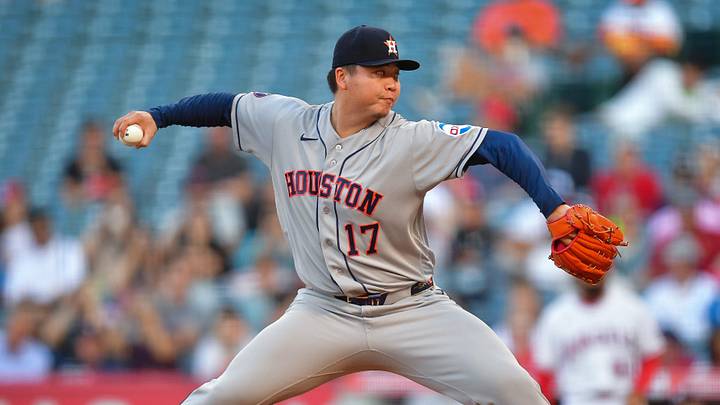
Going to Anaheim was supposed to be the get-right series. The Angels walked into Tuesday’s game 17 games under .500 and had already lost the opener in heartbreaking fashion. And Kai-Wei Teng was on the mound, the same guy who’d spent most of the first two months of the season making the Houston Astros front office look like geniuses.
But the Angels scored two in the first and five in the second and ended up rolling to 10-1 win. It was just one night, but it was more than that. It might just be a blip, but seeing his velocity dip in the midst of a second straight rough start (and the one before it wasn’t great either) has to have the Astros wondering if they’ve gotten all they can out of him.
Kai-Wei Teng's regression is Astros' rotation gamble coming back to Earth
It could be a total overreaction, because if you go back just a couple of weeks ago, Teng looked like he might have been the steal of the winter. He’d pitched so well in relief that the Astros put him in the rotation for good on May 10 and he had a 2.19 ERA through his first 17 outings of the season with 36 strikeouts in 37 innings and just 24 hits allowed.
But on May 29 against Milwaukee, he gave up three runs over five innings with four walks. That’s not ideal. Then Pittsburgh got to him for seven hits and five runs in five-plus innings, both of which were season highs at the time. And Tuesday was even worse than that, with seven runs allowed (five earned) over four innings with seven hits allowed as well. That’s 15 runs allowed in 14 innings over his last three starts to bring his ERA all the way up to 3.71. That may not be a blip. It ma ybe a trend.
Teng's velocity predictably dipped as he went into the rotation, but never as much as on Tuesday. By start, since May 10, he has averaged 93.6 MPH, 93.1, 93.3, 93.7, 93.6 again. But Tuesday against the Pirates, he was down to 92.5 MPH. And it’s not like he’s been fooling anyone with the fastball anyway, allowing 11 hits in 20 at bats against it in those six starts. Losing velocity on an already ineffective pitch is no way to live.
The story was always great. The Astros gave up a marginal prospect to acquire Teng this winter. He was heading into his age-27 season with a 7.30 career ERA in 40.2 innings and wasn’t terribly impressive in the minors either. He was a lottery ticket. And it was paying off for a long time for a team that desperately needed a win.
But even at the peak, Teng's underlying numbers weren’t telling the best story. His 2.19 ERA through those first 17 outings came with a 3.59 FIP and 3.62 ERA. Both are more than acceptable, but it was easy to see a regression coming. When you take gambles on guys like him, you never really know how long it’ll take for the league to adjust.
There’s no need to spiral here, though. The Astros don’t actually need Teng to be an ace. They just need him to be a competent back-end starter, and there’s reason to believe he can still be that. Having three rough starts with what might be a tired fastball isn’t the end for someone who profiles as a fifth starter anyway. Spencer Arrighetti, who is the other surprise (though less of a gamble), has shown to be the real deal and Hunter Brown is close to returning as well.
 Add us as a preferred source on Google