%20%20--%3E%0A%3Csvg%20version%3D%221.1%22%20xmlns%3D%22http%3A%2F%2Fwww.w3.org%2F2000%2Fsvg%22%20xmlns%3Axlink%3D%22http%3A%2F%2Fwww.w3.org%2F1999%2Fxlink%22%20x%3D%220px%22%20y%3D%220px%22%0A%09%20viewBox%3D%220%200%201055.1%20200%22%20style%3D%22enable-background%3Anew%200%200%201055.1%20200%3B%22%20xml%3Aspace%3D%22preserve%22%3E%0A%3Cstyle%20type%3D%22text%2Fcss%22%3E%0A%09.st0%7Bfill%3A%23231F20%3B%7D%0A%09.st1%7Bfill%3A%230E203C%3B%7D%0A%09.st2%7Bfill%3A%23EC4324%3B%7D%0A%09.st3%7Bfill%3A%23FFFFFF%3B%7D%0A%3C%2Fstyle%3E%0A%3Cg%20id%3D%22Template%22%3E%0A%3C%2Fg%3E%0A%3Cg%20id%3D%22Layer_2%22%3E%0A%09%3Cpath%20class%3D%22st3%22%20d%3D%22M58.3%2C200.3h82.4c12.4%2C0%2C21.7-1.5%2C28-4.5c20.2-9.6%2C30.2-26.1%2C30.2-49.3c0-3.2-0.2-9.3-0.6-18.3h-65.1v14.9%0A%09%09c-0.9%2C3.9-3.4%2C5.8-7.5%2C5.8H73.2c-5%2C0-7.5-2.5-7.5-7.5V59.2c0-5%2C2.5-7.5%2C7.5-7.5h52.5c5%2C0%2C7.5%2C2.1%2C7.5%2C6.4v10.8h65.7V55.7%0A%09%09c0-16.3-3.8-28.3-11.4-36.1c-8.8-12.9-24.7-19.3-47.4-19.3H58.9C47%2C0.3%2C38%2C1.7%2C32%2C4.3c-21.3%2C9-32%2C26.1-32%2C51.4v88%0A%09%09c0%2C16.5%2C3.6%2C28.7%2C10.9%2C36.6C20.1%2C193.7%2C35.9%2C200.3%2C58.3%2C200.3z%22%2F%3E%0A%09%3Cpolygon%20class%3D%22st3%22%20points%3D%22596.6%2C64%20596.6%2C0.8%20400.1%2C0.8%20400.1%2C64%20442.7%2C64%20442.7%2C51.3%20466.1%2C51.3%20466.1%2C148.1%20442.1%2C148.1%20%0A%09%09442.1%2C199.9%20554.8%2C199.9%20554.8%2C148.1%20531.5%2C148.1%20531.5%2C51.4%20554.8%2C51.4%20554.8%2C64%20%09%22%2F%3E%0A%09%3Cpolygon%20class%3D%22st3%22%20points%3D%22942.4%2C148.5%20942.4%2C200.2%201055.1%2C200.2%201055.1%2C148.5%201031.8%2C148.5%201031.8%2C51.2%201055.1%2C51.2%201055.1%2C0.8%20%0A%09%09943.1%2C0.8%20943.1%2C51.3%20966.3%2C51.3%20966.3%2C80%20888.9%2C80%20888.9%2C51.3%20912.6%2C51.3%20912.6%2C0.5%20800.1%2C0.8%20800.1%2C51.4%20823.5%2C51.4%20823.5%2C148.6%20%0A%09%09800.1%2C148.6%20800.1%2C200.1%20912.6%2C200.1%20912.6%2C148.6%20888.9%2C148.6%20888.9%2C116.4%20966.3%2C116.4%20966.3%2C148.5%20%09%22%2F%3E%0A%09%3Cpolygon%20class%3D%22st2%22%20points%3D%22315.5%2C83.9%20299.6%2C34.9%20283.7%2C83.9%20232.2%2C83.9%20273.9%2C114.1%20258%2C163.1%20299.6%2C132.8%20341.3%2C163.1%20%0A%09%09325.4%2C114.1%20367%2C83.9%20%09%22%2F%3E%0A%09%3Cpolygon%20class%3D%22st2%22%20points%3D%22715.6%2C83.9%20699.7%2C34.9%20683.8%2C83.9%20632.3%2C83.9%20674%2C114.1%20658%2C163.1%20699.7%2C132.8%20741.3%2C163.1%20%0A%09%09725.4%2C114.1%20767.1%2C83.9%20%09%22%2F%3E%0A%3C%2Fg%3E%0A%3C%2Fsvg%3E%0A)

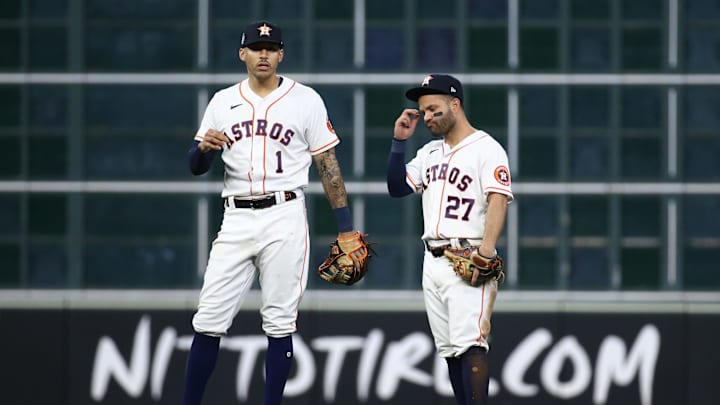
As the Houston Astros scramble to shed salary to stay under the $244 million luxury tax threshold, another related story has been brewing. With the World Baseball Classic on the horizon, we've been getting disappointing news that some of the game's brightest stars won't be suiting up to represent their countries because they could not get their contracts insured.
The Astros have been hit particularly hard by recent development, with Jose Altuve and Carlos Correa both being deemed uninsurable and therefore not able to participate in the WBC. An understanding of how the insurance process works is necessary to explain why these decisions are coming down. Once you take that in, it provides an even more bleak perspective of Houston's financial miscues over the years.
WBC insurance process shines a light on the Astros' poor decisions, as Jose Altuve and Carlos Correa will be forced to sit out
Like all insurance policies, the contract insurance for participants in the WBC is all about mitigating risk. The insurance companies never want to lose, so this all boils down to only approving insurance for players who are not likely to need it.
In layman's terms, this all works by categorizing players into three tiers — chronic condition, intermediate risk, or low risk. "Chronic condition" is a player who has multiple 60-day IL stints on his resume, has had multiple surgeries, or is coming off of offseason surgery.
Altuve fits this mold here because he underwent an offseason procedure on his right foot. He also famously missed time after breaking his right thumb in the 2023 WBC, making him something of a poster child for the risks associated with the competition. Correa's chronic foot issues have been well-documented, so it's easy to see why he fits that bill as well.
Salary plays a role here as well. The insurance covers the player's guaranteed salary, meaning that if he were to get hurt during the tournament, he would still get paid, but his club would be off the hook for those payments. If a player is denied insurance, the club can then assume the risk and allow the player to play if they so choose.
The Astros just aren't going to do that. Altuve will make $33 million this year, which, if he played and suffered an injury, Houston would be on the hook for. The Astros' share of Correa's salary is $21.5 million, but if he were to participate and get hurt, he'd still get his combined $31.5 million salary from the Astros and the Twins. Perhaps a team would be willing to take the gamble on a player making significantly less money, which draws attention to the fact that the several exorbitant salaries on Houston's books were ill-advised maneuvers to begin with.
What we're looking at here are mostly just high-priced players. Plenty of those guys will be participating, with Aaron Judge, Vladimir Guerrero Jr., and Juan Soto serving as prime examples. Instead, it's the combination of inflated salaries, lengthy injury histories, and advanced ages that have made Altuve and Correa uninsurable. It's not a leap to add declining performance to that list of characteristics, which is irrelevant to the insurance process, but serves to highlight the error of the Astros' ways.
 Add us as a preferred source on Google