%20%20--%3E%0A%3Csvg%20version%3D%221.1%22%20xmlns%3D%22http%3A%2F%2Fwww.w3.org%2F2000%2Fsvg%22%20xmlns%3Axlink%3D%22http%3A%2F%2Fwww.w3.org%2F1999%2Fxlink%22%20x%3D%220px%22%20y%3D%220px%22%0A%09%20viewBox%3D%220%200%201055.1%20200%22%20style%3D%22enable-background%3Anew%200%200%201055.1%20200%3B%22%20xml%3Aspace%3D%22preserve%22%3E%0A%3Cstyle%20type%3D%22text%2Fcss%22%3E%0A%09.st0%7Bfill%3A%23231F20%3B%7D%0A%09.st1%7Bfill%3A%230E203C%3B%7D%0A%09.st2%7Bfill%3A%23EC4324%3B%7D%0A%09.st3%7Bfill%3A%23FFFFFF%3B%7D%0A%3C%2Fstyle%3E%0A%3Cg%20id%3D%22Template%22%3E%0A%3C%2Fg%3E%0A%3Cg%20id%3D%22Layer_2%22%3E%0A%09%3Cpath%20class%3D%22st3%22%20d%3D%22M58.3%2C200.3h82.4c12.4%2C0%2C21.7-1.5%2C28-4.5c20.2-9.6%2C30.2-26.1%2C30.2-49.3c0-3.2-0.2-9.3-0.6-18.3h-65.1v14.9%0A%09%09c-0.9%2C3.9-3.4%2C5.8-7.5%2C5.8H73.2c-5%2C0-7.5-2.5-7.5-7.5V59.2c0-5%2C2.5-7.5%2C7.5-7.5h52.5c5%2C0%2C7.5%2C2.1%2C7.5%2C6.4v10.8h65.7V55.7%0A%09%09c0-16.3-3.8-28.3-11.4-36.1c-8.8-12.9-24.7-19.3-47.4-19.3H58.9C47%2C0.3%2C38%2C1.7%2C32%2C4.3c-21.3%2C9-32%2C26.1-32%2C51.4v88%0A%09%09c0%2C16.5%2C3.6%2C28.7%2C10.9%2C36.6C20.1%2C193.7%2C35.9%2C200.3%2C58.3%2C200.3z%22%2F%3E%0A%09%3Cpolygon%20class%3D%22st3%22%20points%3D%22596.6%2C64%20596.6%2C0.8%20400.1%2C0.8%20400.1%2C64%20442.7%2C64%20442.7%2C51.3%20466.1%2C51.3%20466.1%2C148.1%20442.1%2C148.1%20%0A%09%09442.1%2C199.9%20554.8%2C199.9%20554.8%2C148.1%20531.5%2C148.1%20531.5%2C51.4%20554.8%2C51.4%20554.8%2C64%20%09%22%2F%3E%0A%09%3Cpolygon%20class%3D%22st3%22%20points%3D%22942.4%2C148.5%20942.4%2C200.2%201055.1%2C200.2%201055.1%2C148.5%201031.8%2C148.5%201031.8%2C51.2%201055.1%2C51.2%201055.1%2C0.8%20%0A%09%09943.1%2C0.8%20943.1%2C51.3%20966.3%2C51.3%20966.3%2C80%20888.9%2C80%20888.9%2C51.3%20912.6%2C51.3%20912.6%2C0.5%20800.1%2C0.8%20800.1%2C51.4%20823.5%2C51.4%20823.5%2C148.6%20%0A%09%09800.1%2C148.6%20800.1%2C200.1%20912.6%2C200.1%20912.6%2C148.6%20888.9%2C148.6%20888.9%2C116.4%20966.3%2C116.4%20966.3%2C148.5%20%09%22%2F%3E%0A%09%3Cpolygon%20class%3D%22st2%22%20points%3D%22315.5%2C83.9%20299.6%2C34.9%20283.7%2C83.9%20232.2%2C83.9%20273.9%2C114.1%20258%2C163.1%20299.6%2C132.8%20341.3%2C163.1%20%0A%09%09325.4%2C114.1%20367%2C83.9%20%09%22%2F%3E%0A%09%3Cpolygon%20class%3D%22st2%22%20points%3D%22715.6%2C83.9%20699.7%2C34.9%20683.8%2C83.9%20632.3%2C83.9%20674%2C114.1%20658%2C163.1%20699.7%2C132.8%20741.3%2C163.1%20%0A%09%09725.4%2C114.1%20767.1%2C83.9%20%09%22%2F%3E%0A%3C%2Fg%3E%0A%3C%2Fsvg%3E%0A)

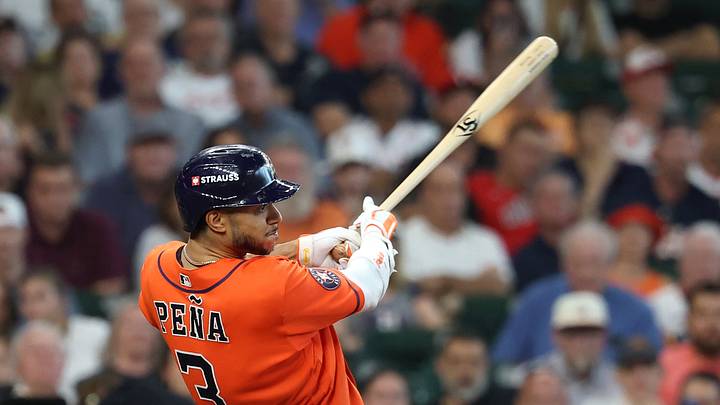
It's a question that is going to get louder all offseason. What are the Houston Astros going to do about their Jeremy Pena problem?
Make no mistake, the Astros do have a Jeremy Pena problem. Pena is going into his final year of arbitration. He is a free agent after next season, and realistically, we have no idea how long (or how many games) will be played next season.
What we do know is this: there is only one person who will make the Astros decision on Jeremy Pena, and his name is Jim Crane.
The Astros owner will need to decide if he will meet Scott Boras' demands for Pena to sign an extension, or if he will charge whomever his new GM will be to find the best possible deal for the star shortstop and figure out an intermediary plan for the time being.
Unless Crane suddenly has a change of heart and is open to a long term deal for Pena (maybe in the neighborhood of 7 years and $200M), the only logical option is to trade Pena. To have Pena play out his final season or arbitration knowing you have no intention of meeting his demands and accept losing him for nothing but a compensatory draft pick is franchise malpractice.
The Kyle Tucker deal is the framework for what such a deal could look like, and the idea of getting 3 players who could all be major leaguers within a year and that one of them has All-Star potential should be exactly what the Astros are looking for. With the number of World Series caliber teams looking for a shortstop, the prize could be even bigger.
No deal for Pena will have the return of a MLB-ready shortstop, so here are the Astros realistic options for shortsop for 2027:
1) Play Carlos Correa at shortstop.
This isn't as simple at it seems. When Correa returned to Houston, he spoke about how he had been wanting to move to 3B to ease the physical toll on his body. Going into his age-32 season, adding more physical toll to his body while coming off ankle tendon surgery doesn't seem like best of ideas.
This becomes a different equation if the 2027 season is shortened from a lockout. Having Correa play shortstop in a shorter season may be more amenable to him as a one-year stopgap option, provided that the league doesn't try to squeeze in a larger number of games in a shortened time frame that eliminates off days and creates mandatory doubleheaders like the Covid season.
Correa recently said he would play anywhere the team needs him to help the team, but that seemed to be more couched around his returning for the last week of the regular season and a potential playoff run, all of which would up being aborted when his ankle didn't respond as well as hoped.
There is also a question of whether the surgery he had to repair his ankle tendon has taken away any of his mobility, a question that has yet to be answered.
2) Make Nick Allen the starting shortstop.
Allen would be the prime example of filling from within for low cost and no upside. Allen delivered what is far and away the best offensive season of his career (.283 AVG, .327 OBP, .720 OPS, 104 OPS+), but it was across only 162 PA and he should not be expected to perform to such levels again.
Regression closer to his career norms (.221 AVG, .272 OBP, .559 OPS) should be expected. This is the first time Allen had an OPS over .600 let alone .700. Defensively, he can certainly stick the position, but his best role is a depth infielder.
3) Call up Pascanel Ferreras from Triple-A.
Most Astros fans are not familar with Ferreras, who just completed his age-24 season at Sugar Land. Ferreras is not considered a top-30 prospect, but he did have a breakthrough season for the Space Cowboys.
After playing his first 30 games a Double-A Corpus Christi where he hit .263 with a .359 OBP and .763 OPS (solid numbers), he was promoted to Triple-A where he played even better. In 71 games with Sugar Land, Ferreras hit .305 with a .370 OBP and .837 OPS. In 307 PA with the Space Cowboys, Ferreras had 6 HR, 24 doubles, 1 triple, 46 RBI and scored 41 runs.
Whether or not the team believes he can stick as a MLB shortstop is debatable. He made 8 errors acorss 46 games at shortstop last season, while also playing 2B (30 games) and 3B (23 games).
Ferreras was the last pick (614th) of the last round (20th) in the 2023 MLB Draft. He is listed at 5-foot-7 and 185 pounds. If the offensive gains made this past season in the minors stick, he may hit enough to be a MLB regular. It's certainly a risk with upside.
Currently, the only Top-30 prospect in the Astros system at SS is Max Holy, who moved up to Double-A last season and needs to show a lot of improvement with the bat. He is projected to be a strong defender. He is likely 2 years away.
4) Sign Mauricio Dubon in free agency.
Dubon will be entering his age-32 season, but he is coming off his best offensive season and he is still a terrific defender. He can play essentially anywhere, though shortstop was his natural position. A fan favorite, Astros fans would welcome him with open arms if he were to return. Most fans were angry when he was traded to the Braves last offseason, and the team desperately missed his versatility in 2026. Dubon would have been their everyday CF.
Coming off a season in which he set career highs in HR, RBI, SB, BB, H, R, 2B, AB and total bases, Dubon will probably require a multi-year deal, but a 2-year, $18M deal shouldn't stop the Astros from bringing him back.
Dubon was worth 6 OAA (outs above average) at shortstop last season, despite only starting 51 games at the position.
There are other free agent shortstops available: Orlando Arcia (32),J.P. Crawford (32,)Paul DeJong (33),Ha-Seong Kim (31),Isiah Kiner-Falefa (32),Jorge Mateo (32),Kevin Newman (33), and Zack Short (32). None of them can hit and some of them aren't MLB-caliber defenders at SS anymore. That would make it more imperative that if the Astros went the free agent route, they focus on Dubon, as he should be in some demand. (It is possible Bo Bichette opts out of his deal with the Mets to go back on the market seeing a big deal to play SS, but that goes against the Astros ideals of not signing big contracts).
 Add us as a preferred source on Google