%20%20--%3E%0A%3Csvg%20version%3D%221.1%22%20xmlns%3D%22http%3A%2F%2Fwww.w3.org%2F2000%2Fsvg%22%20xmlns%3Axlink%3D%22http%3A%2F%2Fwww.w3.org%2F1999%2Fxlink%22%20x%3D%220px%22%20y%3D%220px%22%0A%09%20viewBox%3D%220%200%201055.1%20200%22%20style%3D%22enable-background%3Anew%200%200%201055.1%20200%3B%22%20xml%3Aspace%3D%22preserve%22%3E%0A%3Cstyle%20type%3D%22text%2Fcss%22%3E%0A%09.st0%7Bfill%3A%23231F20%3B%7D%0A%09.st1%7Bfill%3A%230E203C%3B%7D%0A%09.st2%7Bfill%3A%23EC4324%3B%7D%0A%09.st3%7Bfill%3A%23FFFFFF%3B%7D%0A%3C%2Fstyle%3E%0A%3Cg%20id%3D%22Template%22%3E%0A%3C%2Fg%3E%0A%3Cg%20id%3D%22Layer_2%22%3E%0A%09%3Cpath%20class%3D%22st3%22%20d%3D%22M58.3%2C200.3h82.4c12.4%2C0%2C21.7-1.5%2C28-4.5c20.2-9.6%2C30.2-26.1%2C30.2-49.3c0-3.2-0.2-9.3-0.6-18.3h-65.1v14.9%0A%09%09c-0.9%2C3.9-3.4%2C5.8-7.5%2C5.8H73.2c-5%2C0-7.5-2.5-7.5-7.5V59.2c0-5%2C2.5-7.5%2C7.5-7.5h52.5c5%2C0%2C7.5%2C2.1%2C7.5%2C6.4v10.8h65.7V55.7%0A%09%09c0-16.3-3.8-28.3-11.4-36.1c-8.8-12.9-24.7-19.3-47.4-19.3H58.9C47%2C0.3%2C38%2C1.7%2C32%2C4.3c-21.3%2C9-32%2C26.1-32%2C51.4v88%0A%09%09c0%2C16.5%2C3.6%2C28.7%2C10.9%2C36.6C20.1%2C193.7%2C35.9%2C200.3%2C58.3%2C200.3z%22%2F%3E%0A%09%3Cpolygon%20class%3D%22st3%22%20points%3D%22596.6%2C64%20596.6%2C0.8%20400.1%2C0.8%20400.1%2C64%20442.7%2C64%20442.7%2C51.3%20466.1%2C51.3%20466.1%2C148.1%20442.1%2C148.1%20%0A%09%09442.1%2C199.9%20554.8%2C199.9%20554.8%2C148.1%20531.5%2C148.1%20531.5%2C51.4%20554.8%2C51.4%20554.8%2C64%20%09%22%2F%3E%0A%09%3Cpolygon%20class%3D%22st3%22%20points%3D%22942.4%2C148.5%20942.4%2C200.2%201055.1%2C200.2%201055.1%2C148.5%201031.8%2C148.5%201031.8%2C51.2%201055.1%2C51.2%201055.1%2C0.8%20%0A%09%09943.1%2C0.8%20943.1%2C51.3%20966.3%2C51.3%20966.3%2C80%20888.9%2C80%20888.9%2C51.3%20912.6%2C51.3%20912.6%2C0.5%20800.1%2C0.8%20800.1%2C51.4%20823.5%2C51.4%20823.5%2C148.6%20%0A%09%09800.1%2C148.6%20800.1%2C200.1%20912.6%2C200.1%20912.6%2C148.6%20888.9%2C148.6%20888.9%2C116.4%20966.3%2C116.4%20966.3%2C148.5%20%09%22%2F%3E%0A%09%3Cpolygon%20class%3D%22st2%22%20points%3D%22315.5%2C83.9%20299.6%2C34.9%20283.7%2C83.9%20232.2%2C83.9%20273.9%2C114.1%20258%2C163.1%20299.6%2C132.8%20341.3%2C163.1%20%0A%09%09325.4%2C114.1%20367%2C83.9%20%09%22%2F%3E%0A%09%3Cpolygon%20class%3D%22st2%22%20points%3D%22715.6%2C83.9%20699.7%2C34.9%20683.8%2C83.9%20632.3%2C83.9%20674%2C114.1%20658%2C163.1%20699.7%2C132.8%20741.3%2C163.1%20%0A%09%09725.4%2C114.1%20767.1%2C83.9%20%09%22%2F%3E%0A%3C%2Fg%3E%0A%3C%2Fsvg%3E%0A)

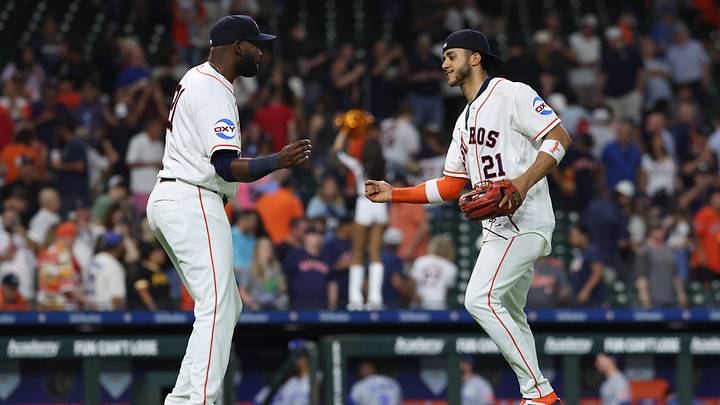
The next general manager of the Houston Astros will have three major tasks in the offseason and we will have time to tackle all three in detail when the final curtain drops on the season. Jeremy Pena's hot streak in the homestand has highlighted the major decision that will need to be made on him. He is the next major position player to be ready for a major pay day. He has one more season of club control left, so the big question is whether that pay day should happen in Houston or whether it should happen somewhere else.
What I like to do in these situations is play agent. What am I going to end up asking for? Fortunately, Fangraphs.com has a benchmark for these conversations with their WAR formula. If you have read my work for awhile you know I don't like to zero in on one source of information. I like to marry BWAR (baseball-reference.com WAR) and FWAR (Fangraphs.com WAR) to get a general consensus on a player.
The general consensus at Fangraphs is that each win above replacement is worth around eight million dollars a year. That figure obviously gets adjusted for inflation, so one of the benefits of a long-term contract is that this figure is frozen in at the time of signing. It is quite possible that the figure will be nine or ten million a win by the end of the decade. So, getting any player for eight million a win could be considered a bargain. That said, let's take a look at where Pena has been before we jump off on what he could be in the future.
BWAR | FWAR | AVG | |
|---|---|---|---|
2022 | 5.0 | 3.3 | 4.2 |
2023 | 3.9 | 2.7 | 3.3 |
2024 | 3.9 | 2.8 | 3.4 |
2025 | 5.7 | 5.8 | 5.8 |
2026 | 3.8 | 3.3 | 3.6 |
AVG | 4.46 | 3.58 | 4.06 |
Before we break down future numbers we should address the differences in BWAR and FWAR. Both are essentially similar in overall assumption, but the inputs are different. The major difference is the source for fielding data. BWAR largely utilizes defensive runs saved which are much more bullish on Pena's defense. FWAR utilizes outs above average and fielding run value. Those are usually more tepid in general and certainly are in Pena's case. There are also some differences between actual offensive production and expected offensive production. That may be gibberish for some of you and there is a lot to the secret sauce, but it is important to know where the differences are when prepping for the future.
Contrary to the "back of the baseball card" gang, careers don't occur in a straight line. A player that averages four wins does not average that into perpetuity. Pena will likely average that for the remainder of his prime and then start tapering off. That tapering off occurs because of injuries, diminishing performance, or both. We can assume he will remain in his prime through his age 32 season. He will be 29 next season, so that will end up being four seasons if they signed an extension after this season.
As an agent, I am presenting my client with a number of options so they can choose for themselves where this likely would go. A player like Pena would likely end up wanting more years than that. In those following seasons (age 33-35) his performance will likely taper off. I'd imagine it would be somewhere between two to three wins a season. I'm an agent so I'm going to assume the high end at three wins. If you wanted to go beyond seven seasons then those following seasons would be assessed between one to two wins a season. We will assume two wins as the agent.
Wins | Cost per win | Total | |
|---|---|---|---|
4 years | 16 | 8 | 128 |
5 years | 19 | 8 | 152 |
6 years | 22 | 8 | 176 |
7 years | 25 | 8 | 200 |
8 years | 27 | 8 | 216 |
What you notice is that the wins are cumulative. So, the average annual value tapers off as the contract grows in length. That is part of the trade off of a long-term contract. So, an eight year contract would end up being 27 million a season in terms of AAV. The Astros have never gone beyond six years under Jim Crane's ownership, so I can't imagine them going longer than eight years, but the AAV continues to taper off when you go beyond eight season. That is how players like Bryce Harper end up signing contracts with such a modest AAV. A hypothetical ten year contract would end up being 25.8 million AAV.
If I am a reputable agent then I am presenting this information to my client and asking him whether he wants long money for short years and shorter money for longer years. That would frame my discussions with the Astros. From there, it is a simple question on the Houston side as to whether they are willing to commit that to Pena. If they aren't then they should seriously consider dealing him in the winter like they did with Kyle Tucker.
As for Houston, there are two major considerations moving forward. First, do you think Pena will be the kind of player outlined above? How long will he be that kind of player? Keep in mind that careers are never a tight bell curve like that. There are ebbs and flows that are impacted by health or the specific aging of the player. If Pena demands eight years and you aren't willing to go beyond six then you have your answer.
We have seen what has happened to Jose Altuve as he ages. I'm not a big fan of paying players beyond 35 for that reason. So, I would likely go to a max of seven years. That brings us to the second major consideration. Will a player with 45 career wins by that point be a player that could break into Cooperstown? That might seem like a minor thing, but it isn't when you consider the history of your franchise.
The team already has Jeff Bagwell and Craig Biggio. Jose Altuve will join that group when he retires. They could have added Alex Bregman had they kept him. Carlos Correa is a borderline member of that group depending on what he does these next few years. Is Pena a part of that group or is he more similar to George Springer? Springer is a very good player historically, but not to the level of Hall of Famer. So, which one is Pena?
i'm not Pena's agent and I'm not the general manager. However, when looking at all of this data, I would be inclined to think he is not quite to the level of Bagwell, Biggio, and Altuve. He is a very good baseball player, but a team in the Astros situation can only afford so many good baseball players at top dollar. They certainly can't afford the later years of a long-term contract. I'd offer four or five years at the longer money and then shut it down if he wants to go longer. Either way, it is going to be a difficult negotiation for all involved.
 Add us as a preferred source on Google