%20%20--%3E%0A%3Csvg%20version%3D%221.1%22%20xmlns%3D%22http%3A%2F%2Fwww.w3.org%2F2000%2Fsvg%22%20xmlns%3Axlink%3D%22http%3A%2F%2Fwww.w3.org%2F1999%2Fxlink%22%20x%3D%220px%22%20y%3D%220px%22%0A%09%20viewBox%3D%220%200%201055.1%20200%22%20style%3D%22enable-background%3Anew%200%200%201055.1%20200%3B%22%20xml%3Aspace%3D%22preserve%22%3E%0A%3Cstyle%20type%3D%22text%2Fcss%22%3E%0A%09.st0%7Bfill%3A%23231F20%3B%7D%0A%09.st1%7Bfill%3A%230E203C%3B%7D%0A%09.st2%7Bfill%3A%23EC4324%3B%7D%0A%09.st3%7Bfill%3A%23FFFFFF%3B%7D%0A%3C%2Fstyle%3E%0A%3Cg%20id%3D%22Template%22%3E%0A%3C%2Fg%3E%0A%3Cg%20id%3D%22Layer_2%22%3E%0A%09%3Cpath%20class%3D%22st3%22%20d%3D%22M58.3%2C200.3h82.4c12.4%2C0%2C21.7-1.5%2C28-4.5c20.2-9.6%2C30.2-26.1%2C30.2-49.3c0-3.2-0.2-9.3-0.6-18.3h-65.1v14.9%0A%09%09c-0.9%2C3.9-3.4%2C5.8-7.5%2C5.8H73.2c-5%2C0-7.5-2.5-7.5-7.5V59.2c0-5%2C2.5-7.5%2C7.5-7.5h52.5c5%2C0%2C7.5%2C2.1%2C7.5%2C6.4v10.8h65.7V55.7%0A%09%09c0-16.3-3.8-28.3-11.4-36.1c-8.8-12.9-24.7-19.3-47.4-19.3H58.9C47%2C0.3%2C38%2C1.7%2C32%2C4.3c-21.3%2C9-32%2C26.1-32%2C51.4v88%0A%09%09c0%2C16.5%2C3.6%2C28.7%2C10.9%2C36.6C20.1%2C193.7%2C35.9%2C200.3%2C58.3%2C200.3z%22%2F%3E%0A%09%3Cpolygon%20class%3D%22st3%22%20points%3D%22596.6%2C64%20596.6%2C0.8%20400.1%2C0.8%20400.1%2C64%20442.7%2C64%20442.7%2C51.3%20466.1%2C51.3%20466.1%2C148.1%20442.1%2C148.1%20%0A%09%09442.1%2C199.9%20554.8%2C199.9%20554.8%2C148.1%20531.5%2C148.1%20531.5%2C51.4%20554.8%2C51.4%20554.8%2C64%20%09%22%2F%3E%0A%09%3Cpolygon%20class%3D%22st3%22%20points%3D%22942.4%2C148.5%20942.4%2C200.2%201055.1%2C200.2%201055.1%2C148.5%201031.8%2C148.5%201031.8%2C51.2%201055.1%2C51.2%201055.1%2C0.8%20%0A%09%09943.1%2C0.8%20943.1%2C51.3%20966.3%2C51.3%20966.3%2C80%20888.9%2C80%20888.9%2C51.3%20912.6%2C51.3%20912.6%2C0.5%20800.1%2C0.8%20800.1%2C51.4%20823.5%2C51.4%20823.5%2C148.6%20%0A%09%09800.1%2C148.6%20800.1%2C200.1%20912.6%2C200.1%20912.6%2C148.6%20888.9%2C148.6%20888.9%2C116.4%20966.3%2C116.4%20966.3%2C148.5%20%09%22%2F%3E%0A%09%3Cpolygon%20class%3D%22st2%22%20points%3D%22315.5%2C83.9%20299.6%2C34.9%20283.7%2C83.9%20232.2%2C83.9%20273.9%2C114.1%20258%2C163.1%20299.6%2C132.8%20341.3%2C163.1%20%0A%09%09325.4%2C114.1%20367%2C83.9%20%09%22%2F%3E%0A%09%3Cpolygon%20class%3D%22st2%22%20points%3D%22715.6%2C83.9%20699.7%2C34.9%20683.8%2C83.9%20632.3%2C83.9%20674%2C114.1%20658%2C163.1%20699.7%2C132.8%20741.3%2C163.1%20%0A%09%09725.4%2C114.1%20767.1%2C83.9%20%09%22%2F%3E%0A%3C%2Fg%3E%0A%3C%2Fsvg%3E%0A)

The 2026 Houston Astros are a fascinating dichotomy. The team is at the top of the league in nearly every offensive category, and at the very bottom in every major pitching statistic. Unfortunately, the pitching has been so bad that it has erased all of the progress the Astros have made at the dish, and then some.
But it's the offense that deserves attention. Houston made very little in the way of changes to its position player unit. It was a group that finished 2025 average or worse. The Astros scored 686 runs last season, good for 21st in the league. The team's collective wRC+ was an even 100 — perfectly average.
Going from that to being one of the most productive lineups in the game without any major additions is rare, but that's where we are. Houston overhauled its coaching staff over the offseason. At the time, it seemed like a desperation play by Dana Brown and Joe Espada, both of whom were spared after the franchise's first playoff-less season since 2016, but are both entering the final year of their contracts.
Brown was unhappy with the club's offensive approach last season. The Astros swung early and often, and saw the third-fewest pitches per plate appearances in the MLB. Long-time hitting coaches Alex Cintrón and Troy Snitker fell on the sword, though to some, the real issue was a roster that was almost entirely comprised of free swingers.
In came lead hitting coach Victor Rodriguez with assistant Anthony Iapoce, while offensive coordinator and director of hitting Dan Hennigan was retained. But with the new faces, there wasn't such a dramatic overhaul in strategy despite Houston performing much better at the plate.
Astros new hitting coaches have a different approach, but Yordan Alvarez is truly fueling the resurgence
Chandler Rome of The Athletic did a deep dive on what's different and what's the same with this new regime. In short, the communication and game planning have been radically altered. Rather than endless meetings and a steady stream of analytics, Houston's coaches rely on a group chat.
Hennigan compiles the data and throws it into the chat in a stripped-down, easy-to-understand way. It's allowed the hitters to get insight as to what the opposing pitcher brings to the table and how they can leverage their strengths to solve it. Then, they go to work in the cages with either Rodriguez or Iapoce to work on putting the plan into action.
“They’re athletes because they don’t like meetings,” said Anthony Iapoce, per Rome. “Baseball is such an individualized sport. You don’t want to disrupt their day, especially veteran guys. They have their whole day planned from the night before until they get to the field until they’re ready to play.”
It's worked so far. Astros hitters are seeing more pitches per plate appearance, and they're scoring a little over one run more per game. Much of that is a by-product of getting more men on base with walks, with the team's walk rate rising from 7.7% last season to 10.9% through 27 games in 2026.
But aside from presenting the information in a different way, there isn't much that's actually different in the plan of attack.
As Jeremy Peña explained, “I wouldn’t necessarily say the message is different, I would just say that, as a team, we’re really buying into the plan. We’re passing the baton to the next guy. It feels like we trust every single person in the lineup. You don’t need to be a hero. Get on base, pass the at-bat to the next guy and good things happen.”
That was the same message under the old regime, though. They're not actually prioritizing drawing more walks, though that's been the result so far.
“I don’t think at any point we’ve said, ‘Hey, let’s avoid chase,’” Hennigan said.
Meanwhile, the lead man, Rodriguez, concurred, "The walks, seeing pitches is the result of a good approach. We don’t preach: ‘Hey, take pitches, take walks.’ No. All the work we do is about hitting.”
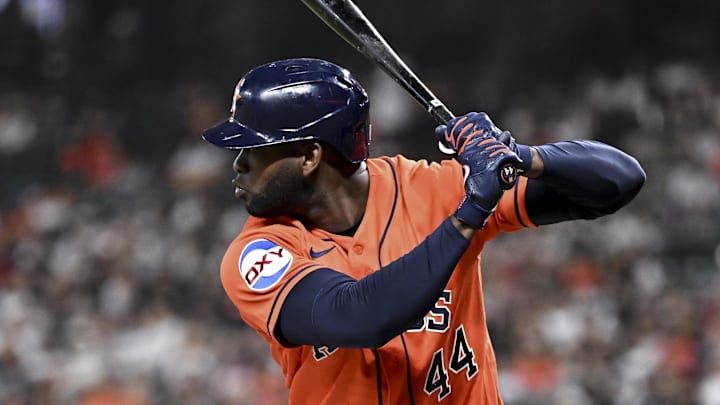
This all obscures the real truth of the matter. The primary reason the Astros' offense is more productive is that Yordan Alvarez is on fire.
Compare the hitters' performances from last season to this season, and it becomes abundantly clear. Here's the OPS breakdown for all of the regulars comparing 2025 to 2026 through April 24
Player | 2025 OPS | 2026 OPS |
|---|---|---|
Jeremy Peña | .840 | .653 |
Carlos Correa | .785 | .729 |
Jose Altuve | .771 | .788 |
Christian Walker | .717 | .869 |
Cam Smith | .671 | .705 |
Isaac Paredes | .809 | .668 |
Jake Meyers | .727 | .704 |
Yainer Diaz | .701 | .571 |
Yordan Alvarez | .797 | 1.247 |
One of these things is not like the others. The 2026 sample size still isn't huge, but it's getting to the point where we can begin gleaning some meaningful information. Many Astros' hitters have performed roughly the same. Some are significantly worse. But only Christian Walker and Yordan Alvarez show significant swings in the positive direction.
Walker is a bit misleading, though. He got off to a torrid start, but since April 15, a nine-game stretch, he's slashing just .194/.316/.323.
The real difference has been a healthy and productive Yordan Alvarez. Many folks forgot that Alvarez is one of the very best hitters in baseball, and now that he's back, he's reminding everyone of how great he truly is. At this point in the season, he's tied for the major league lead in homers with 11, and he's walking at a 15.7% clip while striking out just 9.1% of the time.
That sort of production from just one player can make a lineup look a whole lot better. So while it's true that the Astros are taking more pitches, the overall impact hasn't necessarily been from the coaches repackaging the same message in a different form. It's been Alvarez getting back to crushing baseballs day in and day out.
 Add us as a preferred source on Google