%20%20--%3E%0A%3Csvg%20version%3D%221.1%22%20xmlns%3D%22http%3A%2F%2Fwww.w3.org%2F2000%2Fsvg%22%20xmlns%3Axlink%3D%22http%3A%2F%2Fwww.w3.org%2F1999%2Fxlink%22%20x%3D%220px%22%20y%3D%220px%22%0A%09%20viewBox%3D%220%200%201055.1%20200%22%20style%3D%22enable-background%3Anew%200%200%201055.1%20200%3B%22%20xml%3Aspace%3D%22preserve%22%3E%0A%3Cstyle%20type%3D%22text%2Fcss%22%3E%0A%09.st0%7Bfill%3A%23231F20%3B%7D%0A%09.st1%7Bfill%3A%230E203C%3B%7D%0A%09.st2%7Bfill%3A%23EC4324%3B%7D%0A%09.st3%7Bfill%3A%23FFFFFF%3B%7D%0A%3C%2Fstyle%3E%0A%3Cg%20id%3D%22Template%22%3E%0A%3C%2Fg%3E%0A%3Cg%20id%3D%22Layer_2%22%3E%0A%09%3Cpath%20class%3D%22st3%22%20d%3D%22M58.3%2C200.3h82.4c12.4%2C0%2C21.7-1.5%2C28-4.5c20.2-9.6%2C30.2-26.1%2C30.2-49.3c0-3.2-0.2-9.3-0.6-18.3h-65.1v14.9%0A%09%09c-0.9%2C3.9-3.4%2C5.8-7.5%2C5.8H73.2c-5%2C0-7.5-2.5-7.5-7.5V59.2c0-5%2C2.5-7.5%2C7.5-7.5h52.5c5%2C0%2C7.5%2C2.1%2C7.5%2C6.4v10.8h65.7V55.7%0A%09%09c0-16.3-3.8-28.3-11.4-36.1c-8.8-12.9-24.7-19.3-47.4-19.3H58.9C47%2C0.3%2C38%2C1.7%2C32%2C4.3c-21.3%2C9-32%2C26.1-32%2C51.4v88%0A%09%09c0%2C16.5%2C3.6%2C28.7%2C10.9%2C36.6C20.1%2C193.7%2C35.9%2C200.3%2C58.3%2C200.3z%22%2F%3E%0A%09%3Cpolygon%20class%3D%22st3%22%20points%3D%22596.6%2C64%20596.6%2C0.8%20400.1%2C0.8%20400.1%2C64%20442.7%2C64%20442.7%2C51.3%20466.1%2C51.3%20466.1%2C148.1%20442.1%2C148.1%20%0A%09%09442.1%2C199.9%20554.8%2C199.9%20554.8%2C148.1%20531.5%2C148.1%20531.5%2C51.4%20554.8%2C51.4%20554.8%2C64%20%09%22%2F%3E%0A%09%3Cpolygon%20class%3D%22st3%22%20points%3D%22942.4%2C148.5%20942.4%2C200.2%201055.1%2C200.2%201055.1%2C148.5%201031.8%2C148.5%201031.8%2C51.2%201055.1%2C51.2%201055.1%2C0.8%20%0A%09%09943.1%2C0.8%20943.1%2C51.3%20966.3%2C51.3%20966.3%2C80%20888.9%2C80%20888.9%2C51.3%20912.6%2C51.3%20912.6%2C0.5%20800.1%2C0.8%20800.1%2C51.4%20823.5%2C51.4%20823.5%2C148.6%20%0A%09%09800.1%2C148.6%20800.1%2C200.1%20912.6%2C200.1%20912.6%2C148.6%20888.9%2C148.6%20888.9%2C116.4%20966.3%2C116.4%20966.3%2C148.5%20%09%22%2F%3E%0A%09%3Cpolygon%20class%3D%22st2%22%20points%3D%22315.5%2C83.9%20299.6%2C34.9%20283.7%2C83.9%20232.2%2C83.9%20273.9%2C114.1%20258%2C163.1%20299.6%2C132.8%20341.3%2C163.1%20%0A%09%09325.4%2C114.1%20367%2C83.9%20%09%22%2F%3E%0A%09%3Cpolygon%20class%3D%22st2%22%20points%3D%22715.6%2C83.9%20699.7%2C34.9%20683.8%2C83.9%20632.3%2C83.9%20674%2C114.1%20658%2C163.1%20699.7%2C132.8%20741.3%2C163.1%20%0A%09%09725.4%2C114.1%20767.1%2C83.9%20%09%22%2F%3E%0A%3C%2Fg%3E%0A%3C%2Fsvg%3E%0A)

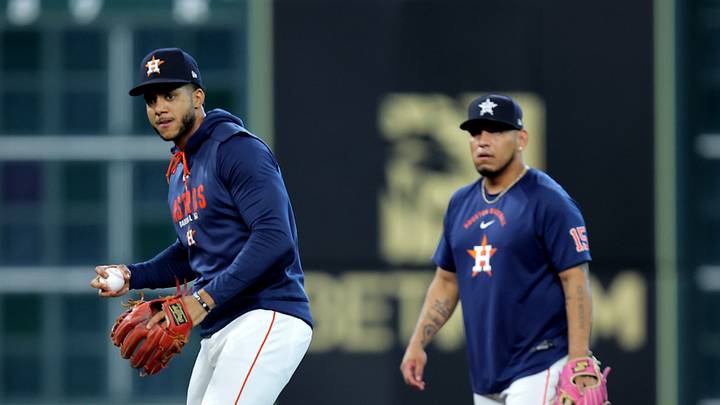
Randy Flores is into his second full week as Houston Astros general manager, and while he still doesn’t have a manager, he’s at the GM Meetings in Las Vegas. He’s there to make sense of a roster he’s barely seen from the inside, and there’s a lockout looming in just a few weeks. That is not much runway for a first-time GM who inherited a division winner, but a weak one at that after getting swept by the White Sox in the Wild Card round.
With all that, nobody will complain about a bit of market intel that tilts in Houston’s favor. This week, MLB Network’s Jon Morosi reported that trade candidates with one year of control left probably won’t get moved for prospects because teams aren’t sure what kind of 2027 season to expect. But to balance the risk, teams might trade those players for others with one year of control. Now, think about the Astros’ depth chart, and you’ll see why that could be big.
Astros' pending free agents could be the perfect trade currency
The Astros have three legitimate trade candidates set to become free agents after the 2027 season. As of right now, that means next season is sort of a last ride for this version of the Astros. But with Carlos Correa expected back from ankle surgery, there are more right-handed infielders than spots for them.
That could be a headache, but maybe not in this case. Usually, teams shopping a player with one year of control want prospects back, or at least someone who will be around for a few years, and Houston’s farm system isn’t stocked enough to win that bidding. But the Astros also don’t have much use for some minor league lottery tickets, given their stated desire to keep competing in 2027. Jim Crane has been pretty clear this isn’t a teardown. It might just be more of a roster reimagining.
So rentals-for-prospects doesn’t do much, and prospects-for-rentals likely isn’t really a possibility. Rentals-for-rentals, though, is another matter entirely.
So a team considering a pitcher with one year left might worry about paying full price in young talent for a season that might be shortened or even canceled entirely. But if the price is another player who will be a free agent a year later, that worry cancels out. Both clubs take on the same risk, fill a hole for a 2027 season that is still expected to be played, and nobody mortgages anything that a labor fight can ruin.
The Astros have the currency for that, so to speak. Isaac Paredes is probably the cleanest fit here. Houston picked up his club option last week after another solid season, hitting .262/.360/.447 with 25 home runs and 94 RBI while limiting strikeouts. He also led the majors with 46 two-out RBI, which may or may not be sustainable. There is a slight wrinkle that his club option could become a mutual one if he finishes in the top-10 of MVP voting, which is possible. But he’s young and reasonably priced. He’s a perfect fit in Houston because of his pull-heavy swing, but he can work elsewhere too.
Jeremy Peña is the biggest chip here. He had another really good season at shortstop, hitting .277/.325/.477, with stretches that made it look like he was morphing into a superstar. He did miss time with injuries, but he’s a heck of a player, and moving him would sting. But one year of a premium shortstop for one year of a frontline starter is exactly the sort of deal this market seemed designed to support.
Christian Walker is a slightly tougher sell. He’ll be 36 next season and is owed $20 million (and has a limited no-trade clause). But he did hit 29 home runs and won a Gold Glove. He’s not dead weight, but he’s not a great value. But in a rental-for-rental deal, there are teams that would be interested.
Everyone knows what the Astros need. It’s rotation help. They have Hunter Brown, but a lot of questions after him. Hayden Wesneski has looked good, but the sample is limited. Peter Lambert had a nice year, but he faded down the stretch. Tatsuya Imai was a disappointment and looked much better in the bullpen. Cristian Javier is a question mark. There are prospects, but we all know young pitching can struggle. Plus, the bullpen has innings to replace too.
Not every name Morosi mentioned in the linked tweet is realistic. Logan Gilbert pitches for a division rival. The Marlins reportedly aren’t planning on trading Sandy Alcantara this winter after picking up his option. But the specific names are less important than the idea behind it. If clubs really are willing to pair one-year players to hedge against an iffy 2027, the team holding three of them, with an obvious need and a ticking clock, is in great shape to take advantage.
It also helps that Flores didn’t build this roster, so he isn't attached to anyone. He doesn’t have time to rebuild it before the lockout hits, but he might not have to. Houston’s biggest structural problem might be the thing that helps them get the pitcher they need.
 Add us as a preferred source on Google